Ask a tool forum what to buy and the answer comes back in red almost every time: Milwaukee M18 FUEL, whatever the category. The tools are excellent, and the prices say so. For a contractor putting a driver through 200 fasteners a day, that math holds. For me, working weekends on my own house, it mostly doesn’t.
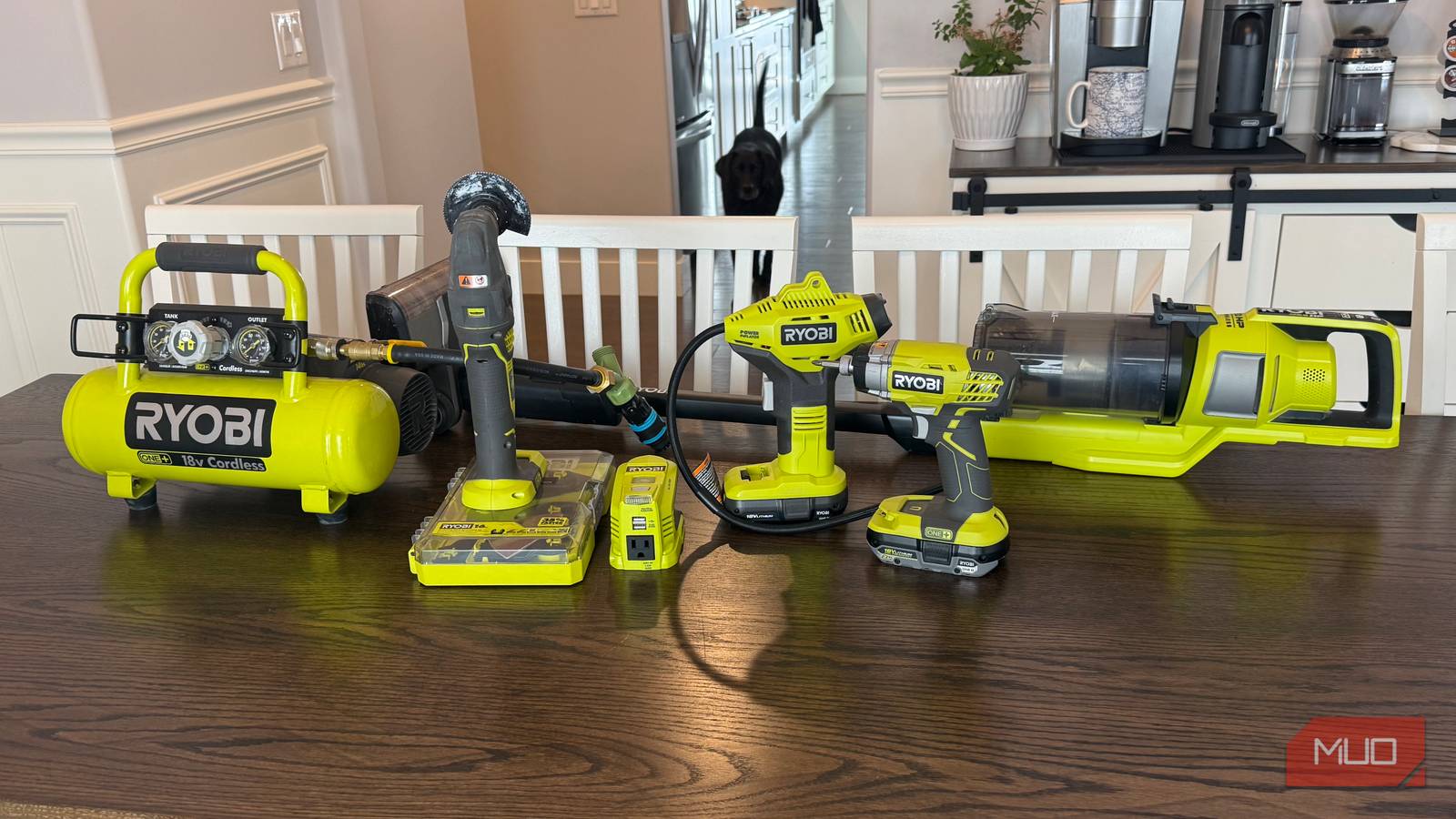
I built my whole workshop around Ryobi ONE+ instead, and after years of real projects, six of those green tools have never once left me wishing I’d paid triple. These are the jobs where Milwaukee money buys you nothing extra.
The impact driver sinks the same screws
Ryobi’s $69 driver against Milwaukee’s $179
My Ryobi ONE+ impact driver has set every deck screw, ledger bolt, and cabinet fastener on my house for years. It runs about $69 with a battery and charger. The Milwaukee M18 FUEL version lists near $179 for the bare tool, before you add a pack. Both drive a long structural screw into framing without predrilling and stop clean.
The Milwaukee spins faster and shrugs off heavier abuse, which matters on a crew running all day. In my garage, the Ryobi finishes the same task and then sits until next weekend. Speed I never use isn’t worth the upcharge. It’s the tool I reach for before the drill on almost every project.
The circular saw cuts a straight line either way
The brushless premium you won’t feel
I’ve broken down more plywood and cut more framing lumber with my Ryobi ONE+ circular saw than any other saw I own. It runs $79–$99 depending on the sale. Milwaukee’s M18 FUEL circular saw sits closer to $199 bare, and it earns that on a jobsite where a brushless motor rips 4x material all afternoon. My cuts are shorter and further apart.
A weekend of shelving or a single fence repair never taxes the Ryobi’s motor or drains a pack before the job is done. Blade quality matters more than the badge here. Swap in a decent 40-tooth blade and the green saw leaves an edge clean enough for anything I build.
Built for bursts, not all-day cutting
Nothing else trims a door jamb for new flooring or flush-cuts a stubborn nail like an oscillating tool, and mine wears a Ryobi badge. Bare, it’s around $79. The M18 FUEL equivalent runs near $149 and adds a brushless motor plus a quicker blade-change system.
Those upgrades help when you’re cutting drywall or hardwood hour after hour. I use mine in bursts, a few cuts to fit a transition strip, then back in the drawer. For occasional plunge cuts and grout removal, the vibration and the cut look identical to me. The blades wear out long before the tool does, and a Ryobi blade fits a Milwaukee arbor anyway.
The random orbit sander leaves the same finish
Paper grit matters more than the motor
A random orbit sander is a finishing tool, and finish comes down to paper grit and patience, not motor pedigree. My Ryobi ONE+ sander cost about $59 bare and has smoothed tabletops, cabinet doors, and a deck railing I refinished last summer. Milwaukee’s M18 version, near $129 bare, runs cooler over long sessions and holds a flatter pad under heavy pressure.
A cabinet shop notices that. I don’t, because I sand for 20 minutes and let the paper do the work. Both leave a surface ready for stain once you climb through the grits. Cordless dust collection is the real upgrade to chase, and Ryobi’s onboard bag handles a home project fine.
The heat gun hits the same temperature
Both clear 900°F, the number that counts
A heat gun is one of those tools you ignore until you need it, then reach for constantly for a week. Mine strips paint, loosens old adhesive, thaws a frozen hose bib, and bends PVC when I ask it to. The Ryobi ONE+ model runs about $45 bare. Milwaukee’s M18 heat gun lists closer to $149. Both push air past 900°F, which is the number that actually matters for most jobs.
The Milwaukee reaches temperature faster and holds it under load, useful if you’re heat-shrinking connections all shift. For a homeowner peeling a few square feet of old paint, hot air is hot air, and the Ryobi delivers it for a third of the price.
The tire inflator fills the same tire
The first green tool to buy
This is the green tool I recommend to people who own zero others. My Ryobi ONE+ inflator lives in the garage, gives a precise pressure reading, and stops itself once it reaches my target. Bare, it’s $39–$59. Milwaukee’s M12 inflator runs near $79 before a battery, and it’s a genuinely great unit with a faster pump and a sturdier build.
For topping off car tires, a wheelbarrow, and the kids’ bikes, the two do the identical job. The Ryobi already shares batteries with the rest of my collection, so there’s no second platform to feed. It’s one of several Ryobi tools under $100 that outperform their price.

- Color
-
Yellow
- Tool Type
-
Impact Driver
Where the Milwaukee upcharge actually pays off
Milwaukee builds its name on tools that survive daily professional abuse, and that name is earned. If you’re on a crew, the extra speed, runtime, and durability return the money fast. A homeowner rarely lives on that edge. The six jobs above finish the same whether the tool is red or green, so the savings go straight into more tools. There are a few Ryobi models where spending more genuinely makes sense, but this list isn’t among them. Build the collection, skip the premium, and keep the sawdust in your own garage.