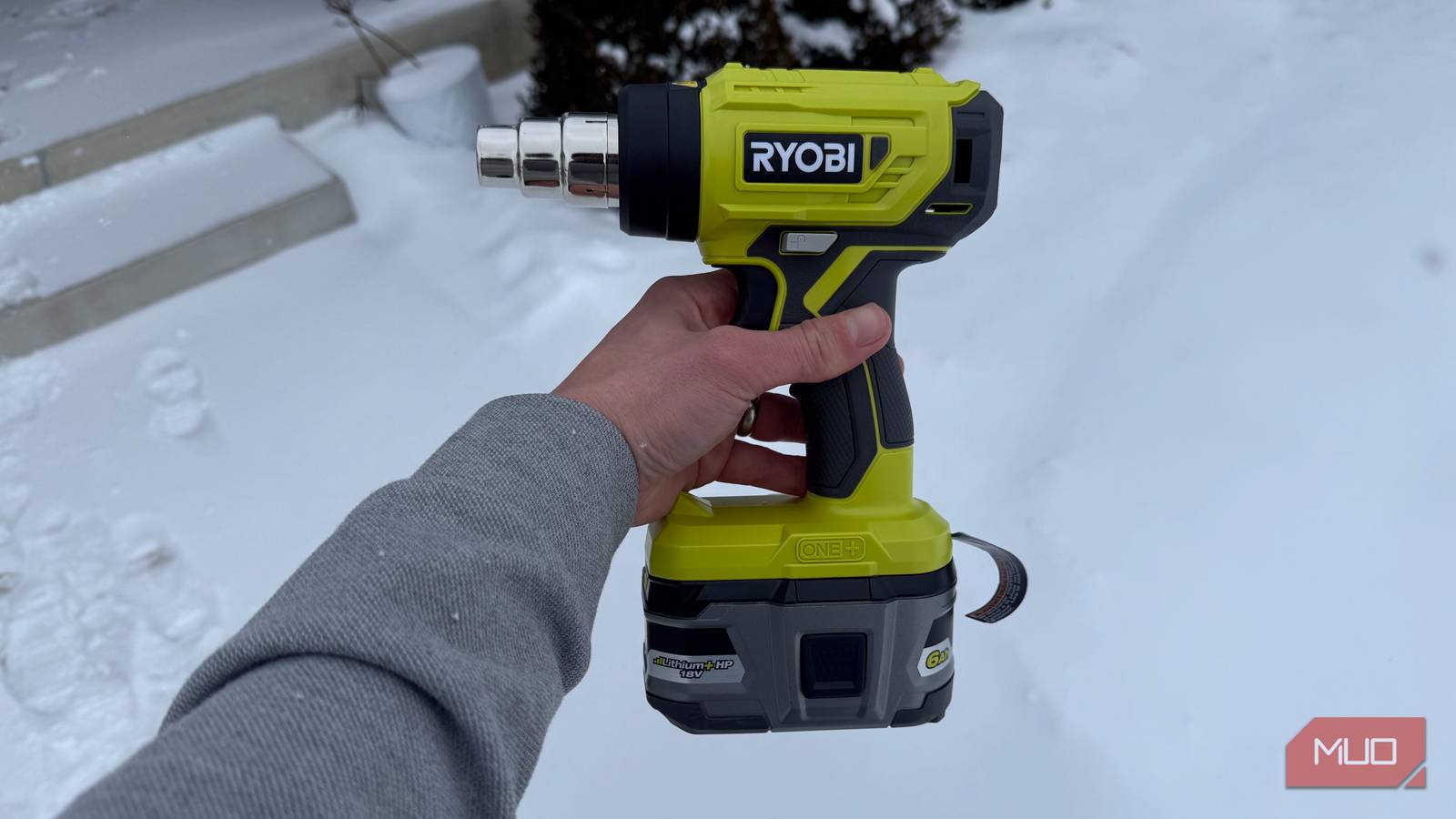
Every cheap Ryobi tool I own came home to solve one problem, and I assumed that’s where its usefulness would end. Then I kept finding work for them. My impact driver wrenches the nut under my washer drum now, and the heat gun is useful in winters thawing frozen locks.
None cost much as a bare tool, and none were marketed for the jobs they now handle most. That gap between price and payoff is a big part of why I think Ryobi tools are way better than people think. I’ve picked the four that strayed furthest from what their packaging promised.
Ryobi ONE+ HP brushless impact driver
The cheapest socket wrench in my garage
My Ryobi impact driver was supposed to drive screws. I used to do most of that with my socket wrenches. Now, I handle it with my driver thanks to a cheap hex-to-socket adapter that snaps into the 1/4-inch chuck and spins bolts without any ratchet handle to reset. That little adapter now does more work around my house than the bits do, and it’s one of several accessories that made my budget power tools far more capable.
Twice a year, I remove the nut at the bottom of my washer drum for a deep cleaning. By hand, that nut fights back. With the impact driver and the right socket, it spins off in seconds. The same setup drove the lag bolts for my PRx folding squat rack and assembled a trampoline, several kids’ bikes, and a couple of hoverboards without a single skinned knuckle.
Going brushless helps on stubborn fasteners, since the motor wastes less energy as heat and gets more out of a compact pack. Ryobi’s brushless HP impact drivers start under $90 bare and drop lower during sales, so even the upgraded version is affordable.
Ryobi ONE+ heat gun
Sold for paint, kept for frozen locks
The Ryobi Heat Gun product page mostly talks up shrink tubing and frozen pipes. Mine earns its keep every Indiana winter on frozen locks. A few seconds of hot air does what a can of de-icer does, without the wait or the drip.
It reaches working temperature in under 10 seconds and tops out at 875°F, which is a different league from a hair dryer. That fast warm-up is exactly why it gets used for small jobs instead of sitting in a drawer. I’ve used it to shrink tubing over wire splices and to soften the adhesive on stubborn stickers so they peel off in one piece. For a frozen pipe, the included deflector nozzle spreads the heat out; keep it moving so you don’t scorch anything nearby.
Ryobi lists it at $84 bare, and factory-blemished units have shown up at Ryobi’s outlet store for far less. It’s also one of the first tools I’d hand anyone setting up a toolkit for a new house.
It cut every outlet hole in my drywall
The multi-tool costs more than anything else here, and it’s still the one I’d defend hardest. When I hung drywall, I used it to cut every outlet hole. A jab saw can do it, but slowly, and the edges rarely come out straight. With the multi-tool, the blade went in right on my pencil line, and the finished cutouts were clean enough to disappear behind a cover plate.
What makes the price easier to swallow is everything that clips onto it. Blade multi-packs cost little next to the tool, and the same head accepts grout blades and sanding pads along with plunge-cut blades. I bought an attachment kit directly from Ryobi, and it turned a tool I’d purchased for one project into something that stays out of the drawer. With the right blade, you can trim molding in place, sand a tight corner, or notch a board that’s already installed.
Brushless versions run noticeably more than Ryobi’s brushed model. Kits that throw in a battery or a jigsaw go on sale often, though. Divide what you pay by every job those cheap blades open up, and it stops looking expensive.
Ryobi ONE+ P704 flashlight
A spare battery with a second job
This is the cheapest tool on the list, and I paid even less for it at Ryobi’s factory outlet than Home Depot charges. It does one thing: turns any 18V pack into a light, useful when the power goes out.
During outages, it’s the first light I grab (after my iPhone), because there’s almost always a charged pack on my six-port charger. A flashlight running on AA cells is only as reliable as the last time someone checked them, and nobody checks them.
It also comes along whenever I climb into the attic. Up there, I need both hands to move across the joists, so I set the light on a joist facing whatever I’m working on. Under sinks, inside closets, and anywhere else the ceiling fixture can’t reach, it does the same job.
Mine is an older xenon model. Ryobi’s current PCL660B LED light puts out 280 lumens for about $30 bare, and the basic P705 sells for around $20, so today’s version gives you more light for the same pocket change.

- Color
-
Yellow
- Tool Type
-
Impact Driver
The battery is what makes a cheap tool worth keeping
None of these four were bought to impress anybody. Each one handled the job I bought it for, then picked up several more along the way. That pattern holds across Ryobi’s catalog because the batteries carry most of the cost. Once a few ONE+ packs live in your garage, every bare tool you add rides on power you’ve already paid for, which keeps the bar for a new purchase low. If you own ONE+ batteries already, start with the impact driver and a socket adapter. It’s the easiest one to try, and it will probably surprise you first.