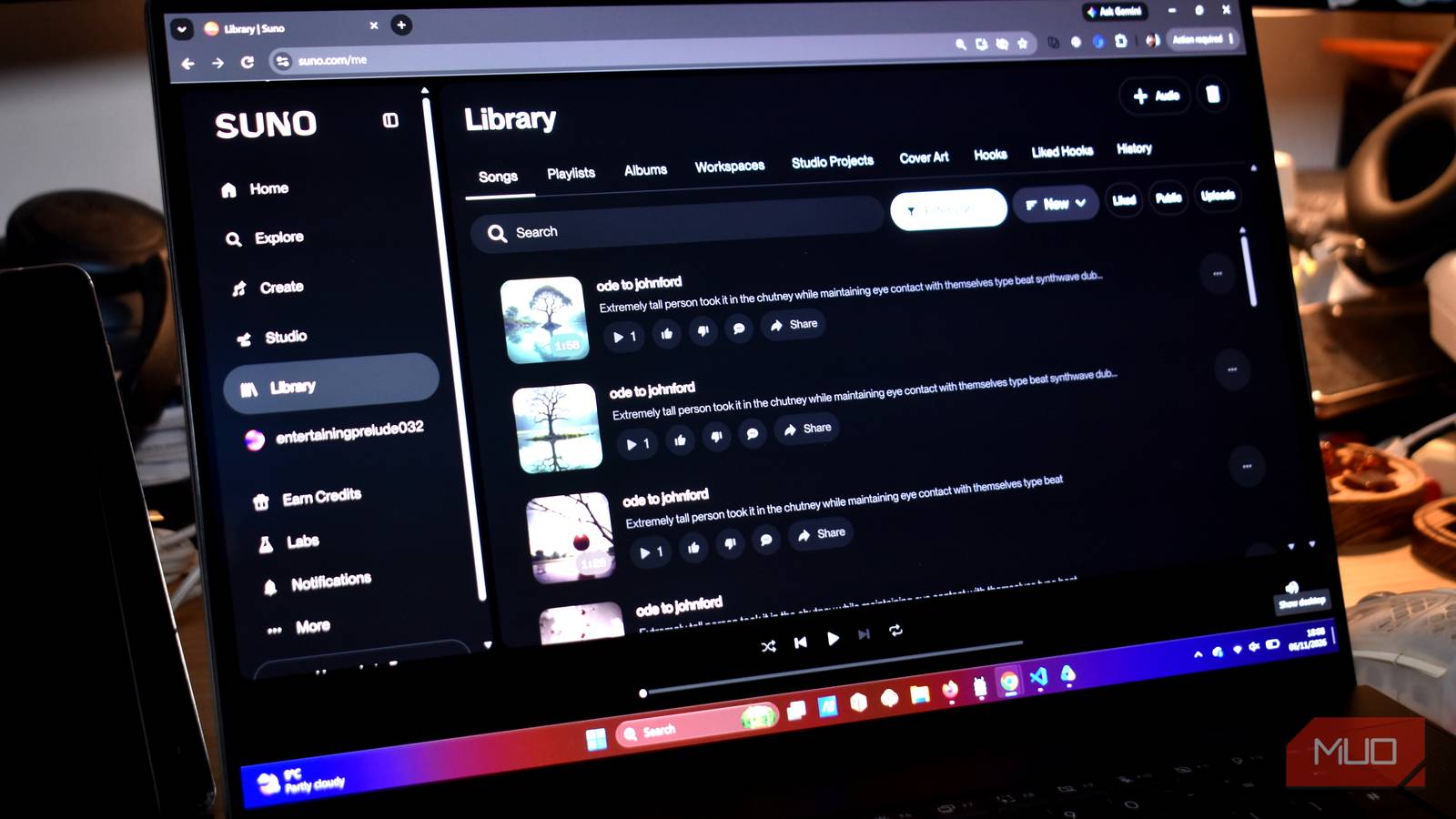
Listening back to my old band’s songs got me thinking about how much recording techniques have changed in a quarter of a century, and whether they’d benefit from a modern musical makeover. Rather than spending hours in Logic Pro, I figured a quick, fun experiment would be to run them through Suno and see what its AI music generator could do.
Revisiting Middleman
I gave Suno a simple instruction and let it reinterpret our original
I started with “Middleman,” a chilled-out, funky number, with some interesting instrumentation. I uploaded it to Suno’s free version and selected Simple mode, so I didn’t need to deal with too many intricate production settings.
I described the uploaded recording as a “Relaxed funk song with steel drum solo”, selected Full Song, Voice and Rhythm / Percussion, and gave Suno one additional instruction: “Rework as a more contemporary version while retaining the rhythm.”
The result was an interesting interpretation, given the basic instructions. It certainly cleaned up the recording and sounded fresh and revitalized. However, it lost much of its charm and nuance.
The ambient traffic noises during the intro were gone, as was the steel drum solo, which was a high point of the track, at least as far as I was concerned. I did like the horn parts, which sounded authentic, and the vocals captured the original’s breathy spirit, although for some reason it decided to drop the verses.
Ultimately, I was impressed with how quickly and efficiently Suno created something that sounded decent, even memorable in places. With that said, the original remained a much more convincing and compelling track.
Turning up the volume
All Night Groove gave Suno a different musical challenge
So I was moderately impressed by what Suno did with Middleman, but I wasn’t quite ready to heap praise on AI’s modeling just yet. Next, I wanted to see what would happen with something rockier. “All Night Groove” seemed like a good choice, and this time I gave Suno even more creative freedom.
I described the original as an “Upbeat funky track with classic synths and driving rhythm”. I selected Full Song but left the other audio categories untouched. My instruction was simply: “Remix this into something more nu-disco.”
Here, the results were far more interesting. With more creative freedom, we could see more clearly what the technology was capable of. And rather than asking Suno to modernize the original while retaining its rhythm, I was effectively inviting it to explore another genre.
Suno’s version felt more in the spirit of our live performances at the turn of the century, and it left me feeling like we missed a trick with some of the guitar synth sounds. The production sounded on point and, frankly, if I heard this on the radio, I’d be nodding in time.
This time I was much more impressed, to the point where I started to feel creeping dread. What does this mean for the future of creative (human) composition?
The AI music debate
It’s fun to experiment, but professional musicians have reasons to worry

I would be lying if I said I didn’t enjoy working with Suno, but mostly because I was revisiting recordings from my past that I hadn’t heard in years. These are songs we put time, effort, and money into creating and recording, and real talent and hard-won experience supported them (present company excepted).
One of my concerns is how AI music generators are trained. The industry has seen instances where record companies and rights holders have challenged AI generators over alleged use of copyrighted material, and broader questions about consent, compensation, and copyright remain contentious.
But on a personal level, I’m more worried about the impact artificially generated music has on working musicians. Some of the same musician friends heard on the original recordings have already been negatively affected by AI music. And if businesses can generate background tracks, advertising jingles, and production music using a few lines of text, quickly and cheaply, they’re likely not going to think about the consequences for the jobbing composer.
Authenticity is the keyword here. Music is more than a combination of notes, instruments, and production techniques. It represents years of practice, collaboration, and personal expression. Your ears may favor the AI versions that I demonstrated here, but how convincing would they be without the original musical inputs?
Would I do it again?
This has been a fun experiment. I enjoyed hearing what Suno did with our recordings, and I was impressed by how quickly and efficiently it produced convincing versions of our songs. I didn’t need a recording studio, production expertise, or an elaborate set of instructions to explore different interpretations of songs we’d made decades ago, and the result left me feeling not just impressed, but inspired.
If we were to regroup, would I hand over production to AI? Certainly not. What this experiment reminded me of, more than anything else, was the fun of making these tracks and the accomplishment we felt. That’s something that is often lost in the AI chatter, but it lies at the heart of every human recording ever committed to wax.