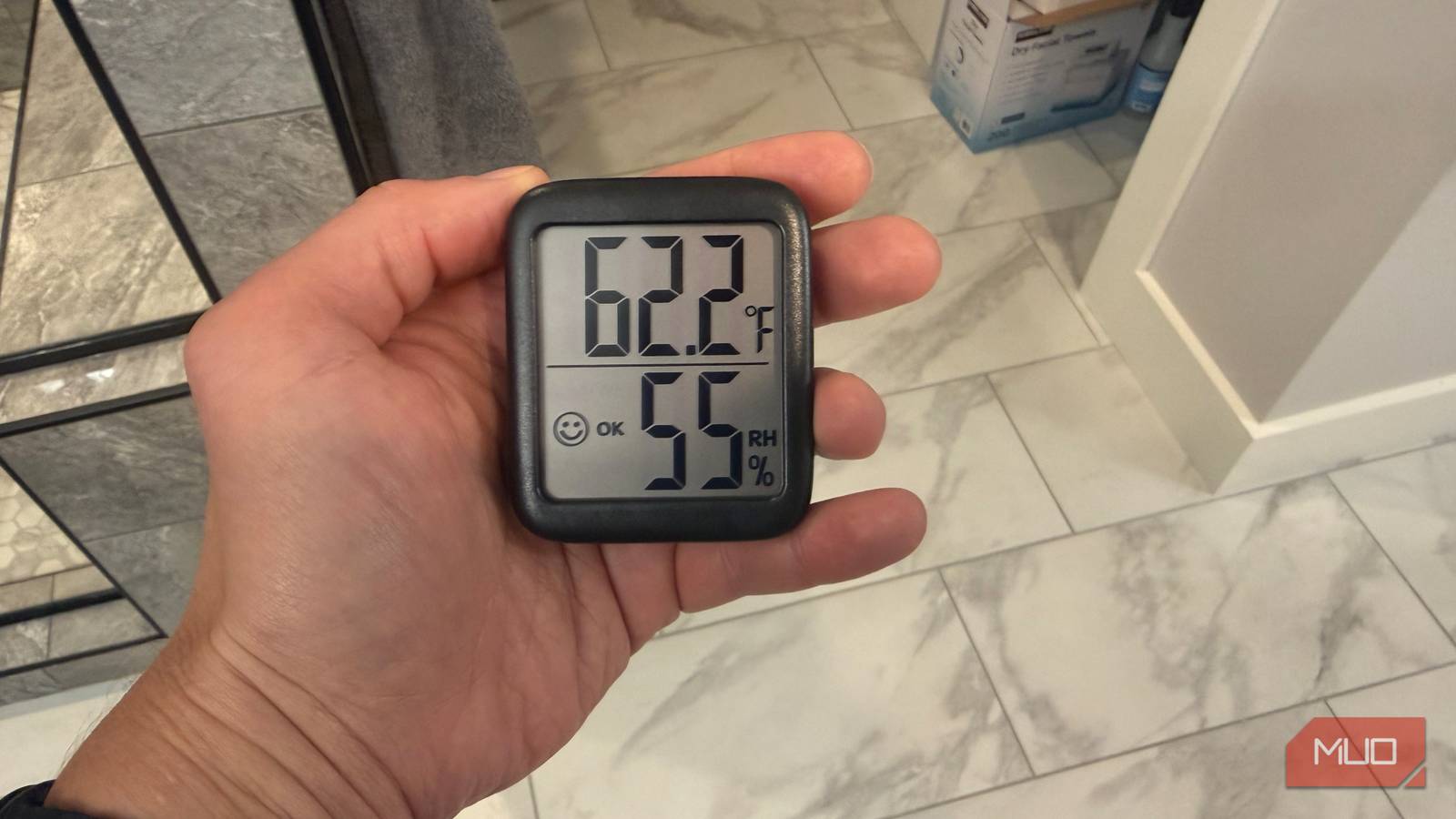
Last winter, nearly every light switch in my house static shocked me; I woke up with raw, stuffy sinuses most mornings, and the hallway floor popped under my feet after dark. I filed all three under the Northern Indiana winter package, right alongside testing my car battery before the first freeze.
Then I bought a $10 two-pack of digital hygrometers and set one on my nightstand. It read 22% humidity. Dry indoor air, which heating creates in almost every cold-climate home, was behind all three. Fixing it took less effort than I expected, and the gadget that exposed it hasn’t moved since.
Three winter annoyances I never connected
Each one came with its own easy excuse
Static shocks felt like a wool-sweater problem. I blamed the carpet and my slippers, then started tapping doorframes before touching anything metal. My home office was the worst spot, since I spend most of the workday there among the desk gadgets that keep my routine on track, and the dual monitor mount bit me almost every morning.
My sinuses got a different excuse. That raw feeling at 6 AM read like allergies or a cold that never arrived. The floors seemed like a third, unrelated issue, probably the house settling. None of it justified a service call, but together it made four months a year miserable.
A $10 hygrometer turned a hunch into a number
My bedroom sat well below the recommended range
The Antonki two-pack costs less than a single good furnace filter. The screen shows temperature up top and humidity below in digits I can read from the doorway. Inside is a CR2032 coin cell, with a magnet and kickstand on the back. Antonki rates it at ±5% for humidity and ±2°F for temperature.
I put one on my nightstand and the other on my office desk, then checked them for a week. The bedroom hovered between 21% and 24%, and the office wasn’t much better. The EPA recommends keeping indoor humidity between 30% and 50%, so my house sat well below the bottom of that range.
Heating cold air is what dries out a house
Your furnace stretches the same moisture thinner

Twelve years of working at an HVAC sensor manufacturer drilled one idea into me: relative humidity is a ratio. A 22% reading doesn’t measure how much water is in the air. Think of it as how full the air is. Warm air has a much bigger tank than cold air.
Say it’s 20°F on a January morning with 70% humidity. That air holds almost no water, and once your furnace warms it to 70°F, the same amount reads roughly 10%. Showers, cooking, and breathing pushed my rooms back into the low 20s. A gas furnace doesn’t remove water; it just heats air that never held much.
One low reading explained all three symptoms
Static, sinuses, and floorboards react to the same air
Static charge needs moisture to bleed away. Below about 30%, the charge you pick up shuffling across carpet stays put until you reach for a doorknob. Sinuses suffer too. Your nose lining stays damp to trap dust and germs, and dry air wicks it out overnight. I was breathing 22% air eight hours a night, so allergies never stood a chance.
Wood soaks up and gives off moisture, slowly, until it matches the room. The National Wood Flooring Association puts the safe zone at 35% to 55%. Below that, boards shrink just enough to rub against their neighbors and their nails. My house is framed with engineered I-joists, which barely move compared to solid lumber, so the creaks had to come from the flooring.
Adding moisture back without fogging the windows
Outdoor temperature sets your safe ceiling

A whole-home Honeywell humidifier connected to my furnace fixed the problem. It adds moisture as the furnace runs, so every room gets it, and there’s no tank to refill. If you have forced air, I think that’s the way to go. It costs a lot more than a plug-in refillable unit, though, and usually needs a water line and an installer. Otherwise, a plain countertop humidifier in the bedroom still helps, since that’s where you breathe dry air for hours.
Dialing in the setting took trial and error, and the hygrometer kept me honest, since too much moisture brings its own problems. On frigid nights, humid air condenses on cold window glass and exterior walls and feeds mold around the frames.
Honeywell’s guidance caps indoor humidity around 35% when it’s 20°F outside, 30% at 10°F, and 25% at 0°F. I aim for the low-to-mid 30s on normal winter days and let it drift lower when an Arctic front rolls through. Without the readout, I’d be guessing in both directions.
Test the hygrometer before you trust it
A bag of damp salt reveals any offset

Antonki’s ±5% spec means a 25% reading could land anywhere from 20% to 30%. To check yours, pour table salt into a bottle cap and dribble in water until it looks like wet sand. Zip it into a plastic bag with the hygrometer overnight. Wet salt holds the bag at 75%, so a 71% reading means yours runs four points low.
Keep it away from supply vents, drafty windows, and the stove, or the numbers won’t reflect the room. After moving one, I wait a few minutes before trusting it.

- Brand
-
Antonki
- Type
-
Thermometer / Hygrometer
A $10 readout ended a winter of guessing
I treated three problems separately for a whole winter, and a $10 gadget traced them to one cause on night one. Before you buy static spray, saline rinse, or floor shims, put a hygrometer in the room. To check it from your phone, a Wi-Fi humidity sensor can feed readings into a smart home dashboard like the one I built from an old iPad. Still, a pair of basic hygrometers in the bedroom and living room is all the proof most homes need this winter.