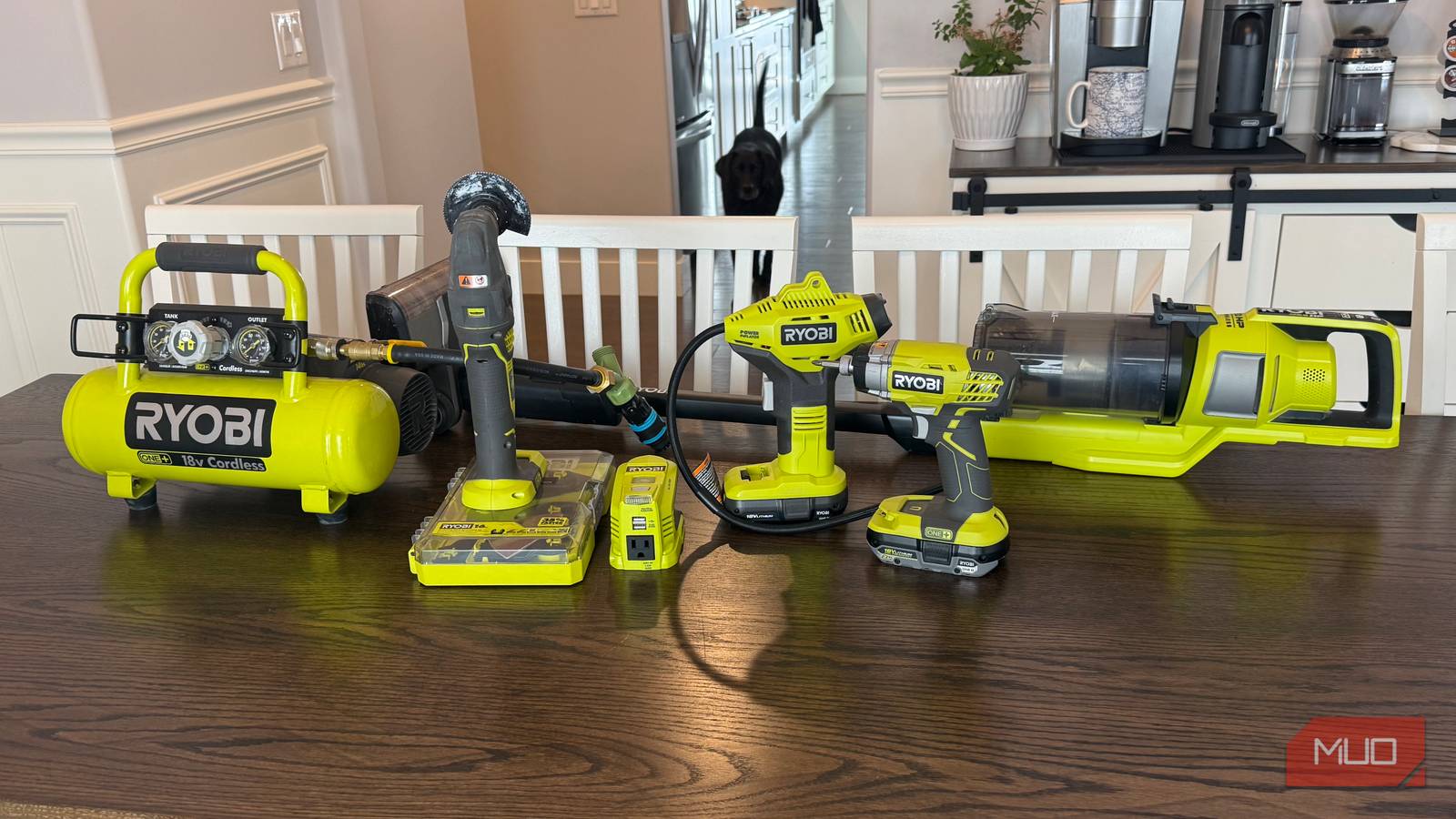
Floor space runs out fast in a small shop. Every tool competes for the same handful of hooks, and anything that sits unused still eats a slot you can’t spare. That pressure changes what counts as a good buy. I built my whole workshop around Ryobi ONE+, and the platform earns its keep on footprint alone: the tools run compact, and a single battery format keeps six chargers from colonizing the wall.
These six are the ones I’d protect if the bench shrank tomorrow. Each is small, each does real work, and none of them asks for more room than it gives back.
One body replaces four specialty tools
No tool in my shop covers more jobs per cubic inch than the Ryobi Oscillating Multi-Tool. Swap the accessory and the same stubby head turns into a flush-cut saw, a scraper, a detail sander, or a grout blade. The first job was undercutting a doorway so laminate could tuck beneath the trim, something a circular saw has no way to reach, and it has been paying rent ever since.
Corners where the orbital sander is too fat to fit? This gets in. Old caulk, a buried nail, a plunge cut in drywall for an outlet box: all one tool. The right accessory set widens that range further without adding a second thing to hang. In a shop with four hooks, a tool that does the work of four fills the easiest slot you own.
Random orbit sander
Finish work without a benchtop station
A dedicated sanding station is a luxury of square footage most of us don’t have. This palm-sized Ryobi Random Orbit Sander does the same finishing work and then disappears onto a hook. The random-orbit motion is the trick: the pad spins and drifts on an offset at once, so it smooths without carving the swirl marks a straight-line sander leaves behind.
You only notice those after stain hits them, which is too late to fix. Rough shelf stock, a flea-market dresser, cabinet doors before paint: this takes them from splintered to sealed in a pass or two with a fresh disc. It weighs about three pounds and stores flat. For the surfaces people actually run their hands across, that’s a lot of capability hanging off one peg.
Impact driver
A short nose reaches where a drill can’t
A drill and an impact driver can both drive screws, but only one fits where the work actually is. The Ryobi Impact Driver’s head is stubby, a couple of inches shorter front to back, and in a cramped shop that gap decides whether you can sink a screw inside a face-frame cabinet or up in a stud bay without taking the assembly apart.
That short nose is a big reason I reach for it before the drill on most jobs. It also sinks fasteners a drill would stall on, using quick rotational hits instead of raw grip, so your wrist stops absorbing the fight. Hang it beside the drill, and you’ve added almost no bulk. What you gain is access, and in a small space, access is the whole game.
Power inverter
A wall outlet without the wall
The Ryobi Power Inverter is always the one that surprises people. Clip it to a ONE+ pack and you get a live 120-volt outlet plus a USB port, no cord running to the wall at all. When the nearest receptacle is across the room, that spares you an extension cord snaking over the floor and a power strip eating bench space. I use it to run a soldering iron at the far end of the garage, top off a phone, or power a small light where no outlet exists.
It puts out 150 watts, plenty for electronics and chargers but not a table saw, so match the load to the tool. It’s one of Ryobi’s stranger ONE+ tools, and also one I won’t give back. A pocket-sized brick that erases a cord earns its hook without an argument.
High-pressure inflator
Air on demand, no tank on the floor
A pancake compressor is a lot of floor to surrender for jobs that take ten seconds. Most of my air needs are small: topping off my 4Runner’s tires, a wheelbarrow, a basketball, an air mattress before company arrives. The Ryobi Inflator handles all of it and lives in a drawer. The digital gauge is the part that earns the space.
Set your target PSI, pull the trigger, and it cuts off on its own once it gets there, so you’re not hunched over a dial second-guessing the number. It climbs to 150 PSI, keeps a sports needle and nozzles clipped onboard, and runs off the same battery as everything else here. A tank compressor still wins for a framing nailer. For the daily stuff, this replaces it and hands the floor back.
Heat gun
A flat tool that unsticks, shrinks, and thaws
A heat gun looks like a hair dryer and shares none of its uses. My Ryobi Heat Gun is flat enough to hang on a nail, and it earns that nail several times a year. Slide shrink tubing over a wire splice and it seals in seconds. A price label or a stubborn adhesive pad lets go the moment warm air hits it.
I’ve softened old paint for scraping with it and coaxed a frozen spigot loose in January. It draws from the ONE+ battery, so there’s no cord to trip over in a narrow aisle and no propane torch to find shelf space for. Corded heat guns cost less, sure, but they chain you to the one outlet you probably don’t have free. For a tool this small and this occasional, the cordless version is the one that actually gets used.

- Color
-
Yellow
- Tool Type
-
Heat Gun
The shared battery is the real space saver
Each of these is compact on its own, but the platform is what makes a small shop workable. Six tools, one battery format, one charger on the wall instead of a shelf lined with them. That’s footprint math a mixed-brand collection never gets to claim. Once you own a couple of ONE+ packs, the next bare tool costs less and asks for nothing but a hook.
Start with the two or three jobs you keep running into, then let the collection grow as the projects do. A tiny workshop doesn’t need fewer capabilities. It needs tools that share, and this lineup does exactly that.