
Ryobi ONE+ batteries don’t wear out on a fixed schedule, and how long one lasts depends on how you treat it between charges. Storage gets most of the attention, and I’ve already explained why keeping packs topped off on a shelf wears them out early.
The habits that do the rest of the damage happen mid-project, when your focus is on the work instead of the battery: charging a pack the moment it comes off the tool, running a compact in a tool that needs more, draining packs to zero, leaving one in the truck, and trusting adapters to know when to stop. Each has an easy fix, and I’ve reworked my own routine around all five.
Heat from the job and heat from the charger stack up
A pack that just finished a long stretch of cuts or drilling comes off the tool warm, and charging it right away pushes more heat into cells that haven’t cooled yet. Lithium-ion cells age faster at high temperatures; you should consider anything above 86°F as elevated. I tried charging straight off the tool once or twice.
Ryobi’s chargers guard against this with a temperature delay that holds off charging until the pack cools, and I’ve watched my 40V charger do exactly that after a round of trimming, blowing, and edging in summer heat that pushed past 90°F. The delay helps, but it can’t undo the heat the cells already absorbed during the job.
Ryobi’s support guidance suggests giving a hot pack about 30 minutes before charging. Now I set warm packs on the bench, slide a cool one into the tool, and charge the warm one later.
Small batteries hit their limits fast under a heavy draw

The 1.5Ah and 2.0Ah compacts bundled in kits are great on a drill/driver. They struggle in anything that pulls hard and steady. My Ryobi stick vacuum proved it: after a few minutes on a compact battery, it would flash and the vacuum would quit. When I pulled the pack and waited a few minutes, it usually showed three of four bars. The battery wasn’t empty.
It was protecting itself from the load. A small pack has less capacity to spread a heavy draw across, so its cells run hotter and work harder for every minute of runtime, and those high-load discharges shorten lithium-ion life. My stick vacuum only gets a 4.0Ah or 6.0Ah pack now, while the compacts stay on light-duty tools. Bigger isn’t automatically better either, so match the pack to the job.
An empty pack keeps losing charge after you set it down
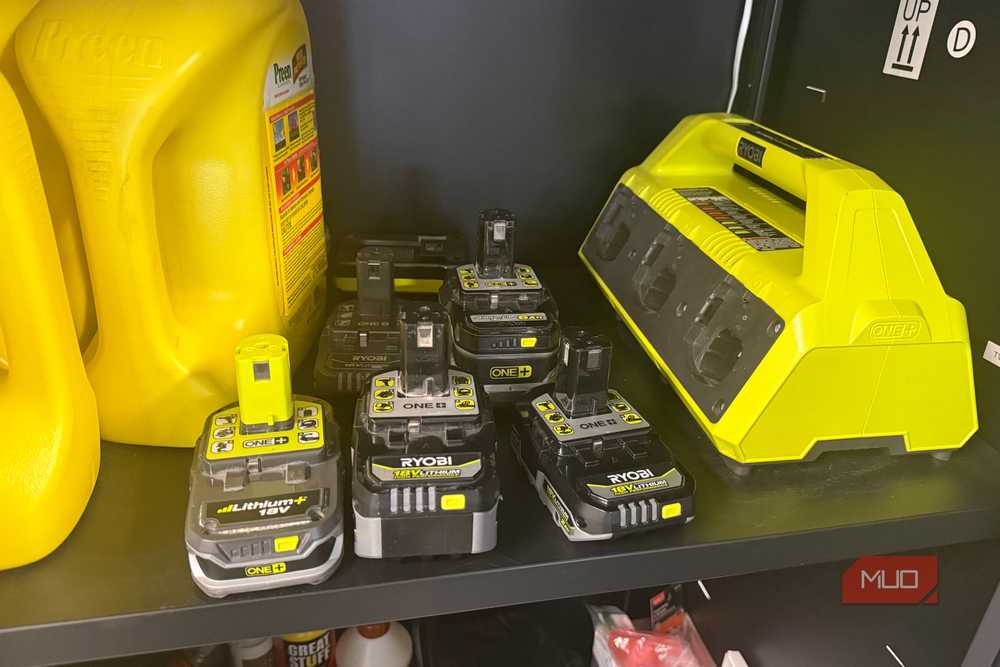
Lithium-ion has no memory effect, so there’s nothing to gain from running a pack all the way down. Ryobi designs its packs and tools to cut power before the cells reach a damaging voltage, but that protection ends when the job does.
A pack sitting near empty keeps losing a little charge through self-discharge, and after enough weeks in a drawer, it can sink so low that the charger reads it as defective or can’t wake it from a protective sleep. The fix costs nothing. Put a drained pack on the charger the same day, even if you pull it off before it’s full. Ryobi’s own manual recommends storing packs at 30%–50% charge, so a partial top-up is exactly what the battery wants.
Leaving a pack parked in the truck
Ryobi’s manual says not to, so I keep the risk small

Ryobi’s battery manual is direct about vehicles: don’t store packs in them. I break that rule anyway. My 18V jump starter and tire inflator ride in my 4Runner with a battery, because I used it for a jump start, and that only helps if the battery is already there. A closed cabin in summer sun gets far hotter than the air outside, while winter cold sags output and blocks charging until the pack warms back up.
My 4Runner stays in my heated garage, which I keep around 50°F–55°F, and rarely sits out in the cold for more than a few hours. I check the pack’s charge every week or so and swap it with one from the garage shelf now and then, so no single battery spends months in the truck. If your vehicle sits outside year-round, keep the tools in it and grab a charged pack when you leave.
Trusting adapters that don’t know when to stop
Low-voltage protection is the spec to check first

My adapter puts a 6.0Ah Ryobi battery in my Dyson V8, which runs longer on it than on Dyson’s own battery. That only works safely because the adapter has low-voltage protection. Ryobi’s own tools are built to shut down before the cells drain too far, but a third-party device has no idea where that line sits unless someone builds a cutoff into it.
Without one, a hungry tool like a vacuum can keep pulling current until the cells drop below a safe voltage, which is the same deep-discharge damage from the last section, only faster. Cheap adapters for Ryobi batteries are worth owning, but read the listing before you buy. Look for low-voltage, over-discharge, or battery protection in the specs, and skip any adapter that doesn’t mention it.
The cheapest Ryobi battery is the one you never replace
None of these fixes take more than a minute or cost a dime. Let warm packs cool before charging, give power-hungry tools a 4.0Ah or larger battery, recharge drained packs the same day, keep tabs on anything riding in your vehicle, and buy adapters with a real cutoff.
A 6.0Ah High Performance pack lists well over $100, so stretching each one an extra year or two pays for itself quickly. Start with the habit you recognize most, then work through the rest the next time you clear off your workbench.