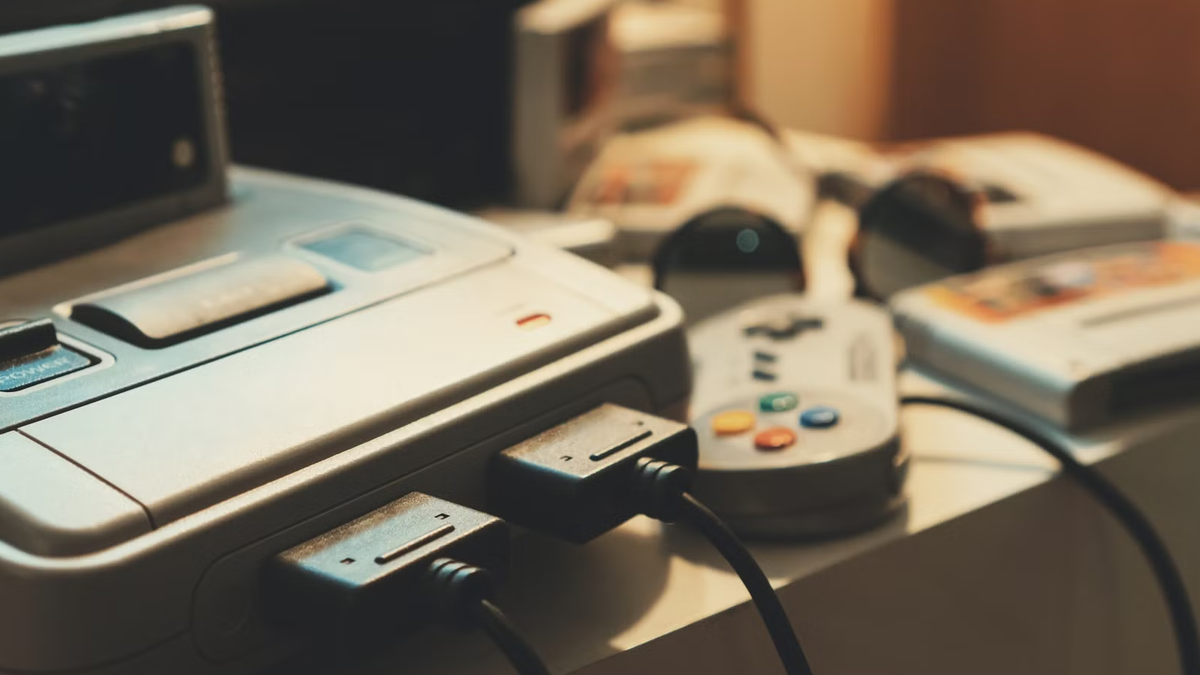
If you owned a Nintendo Entertainment System, you probably remember this ritual by heart: cartridge in, blinking red light, cartridge out, lips to the slot, one hard exhale, cartridge back in, and the game boots. It was the kind of gaming wisdom passed down by older siblings and cousins because it appeared to work often enough to become unquestionable.
I hate to ruin the memory, but blowing into the cartridge never repaired anything. The game may have started afterward, but the useful step was usually removing and reinserting it. Your breath merely took credit while leaving behind moisture that could worsen the contacts over time.
The NES made bad connections unusually common
A VCR in disguise, with a connector to match

The NES front-loading cartridge slot wasn’t the most straightforward engineering choice. Nintendo was introducing the console to a North American market still wary after the 1983 video game crash, so it deliberately avoided presenting the machine as another conventional game system. Its boxy design, covered cartridge bay, and front-loading mechanism made it resemble a VCR or other home entertainment equipment instead.
The redesign also enclosed the cartridge connection. NES designer Masayuki Uemura later explained that Nintendo was concerned about static electricity in the drier North American climate, particularly if children could touch the hardware while inserting a cartridge. The front loader helped keep those connections out of reach.

The North American redesign paired a 72-contact connector with a tray that pushed the cartridge downward after insertion. Unlike a conventional top-loading slot, the mechanism applied relatively little friction when the cartridge entered, so the contacts didn’t receive as much of the light scrubbing action that can remove surface grime. With repeated use, the connector’s spring contacts could also lose pressure or become misaligned, making the electrical connection less reliable even when no obvious dirt was visible.
The 10NES lockout system made those imperfect connections especially noticeable. A corresponding chip inside the cartridge had to communicate successfully with the console before play could begin. When that authentication failed, the NES repeatedly reset itself, producing the familiar blinking power light and flashing screen rather than explaining that the cartridge had made poor contact.
Reinserting the cartridge did the real work
The breath received credit for a mechanical second attempt

Blowing became part of the ritual because it happened between two attempts. Players removed a failed cartridge, blew into it, inserted it again, and watched the game start. The breath was the most memorable step, so it received the credit.
The more likely explanation was the second insertion. Removing and reinserting the cartridge changed how its contacts met the connector inside the console. It could seat the board at a slightly different angle, press it against a cleaner section of a contact, or restore enough pressure for the console and cartridge to communicate properly.

Blowing may occasionally have displaced a loose speck of dust, but it wasn’t a dependable cleaning method. Nor is there good evidence that moisture from a player’s breath routinely bridged the contacts or reduced resistance long enough to start the game. The NES booted because the cartridge made a better connection on the next attempt, not because the breath had repaired the underlying fault.
This also explains why the ritual felt so convincing. I certainly never tried the important control experiment of removing the cartridge, waiting the same length of time, and reinserting it without blowing. When the game worked after the familiar sequence, the successful attempt reinforced the belief that every step had been necessary.
Moisture made the long-term problem worse
Cartridge contacts didn’t need your contribution

Cartridge contacts are exposed whenever the Game Pak is removed, making moisture and contamination especially unhelpful.
Although the breath probably wasn’t responsible for making the game start, it could still leave something behind. Exhaled air contains moisture and microscopic contaminants rather than pure water. Repeatedly depositing them onto metal contacts can encourage tarnish or corrosion, especially where protective plating has already worn or been damaged.
Nintendo also explicitly warned owners not to blow on Game Pak connectors or allow them to get wet or dirty, as doing so can damage the cartridge or console. Properly caring for retro consoles and games means keeping moisture away from the contacts and using an appropriate cleaner when grime actually needs to be removed.
That doesn’t mean every darkened contact or green patch on a surviving cartridge was caused by someone blowing into it. Poor storage, humidity, spills, handling, and ordinary aging can all contribute to corrosion. However, regularly depositing warm moisture onto the contacts of an already unreliable connection certainly didn’t improve its chances.
The habit could therefore become self-reinforcing. As the cartridge or connector became less reliable, players blew into it more frequently. Every successful reinsertion strengthened their belief in the ritual, while any moisture or contamination left behind could make future connection problems more likely.
The NES problem became a cartridge superstition
Nintendo changed the hardware, but the ritual survived

Nintendo addressed dirty contacts with an official NES Cleaning Kit rather than recommending the method players had already invented. Its later NES-101 redesign also abandoned the original tray mechanism and returned to a conventional top-loading connection closer to the layout used by the Japanese Famicom.
The newer model still accepted the same 72-contact NES cartridges, but it didn’t force them through the original front-loading and press-down mechanism. Whatever Nintendo’s broader reasons for the revision, it eliminated one of the original system’s most failure-prone components.
By then, however, blowing into cartridges had escaped the NES and followed Nintendo into later video game generations. The Game Boy arrived in the United States in 1989, followed by the Super Nintendo in 1991 and the Nintendo 64 in 1996. All three used direct cartridge slots rather than the NES’s front-loading tray mechanism.

Those later systems could still suffer from dirty, corroded, or poorly seated contacts. Removing and reinserting a cartridge could therefore make a game work on the second attempt, just as it sometimes had on the NES. The difference was that they didn’t share the original NES’s unusually troublesome loading mechanism.
Players blew into those cartridges, anyway. The ritual had become detached from the hardware problem that helped popularize it. Children copied older siblings, friends copied one another, and every successful second attempt seemed to confirm that the breath had worked again.
Your lungs were never a repair tool
If the NES has spent years in storage, safely booting an old retro gaming console begins with checking it for dust, corrosion, damaged cables, and other visible deterioration before treating it like a normally functioning system.
For a blinking NES today, power off the console and remove the cartridge. Repair specialists commonly use a lint-free swab lightly moistened with high-purity isopropyl alcohol to clean stubborn contamination from the cartridge contacts, then let them dry completely before testing. If several clean cartridges still fail, the console connector may need deeper cleaning, adjustment, repair, or replacement.
That approach addresses the actual causes, including contamination, corrosion, weak contact pressure, and poor alignment. Removing and reinserting the cartridge may have helped you reach the title screen, but the breath itself was never the fix. It was simply the most theatrical part of trying again.