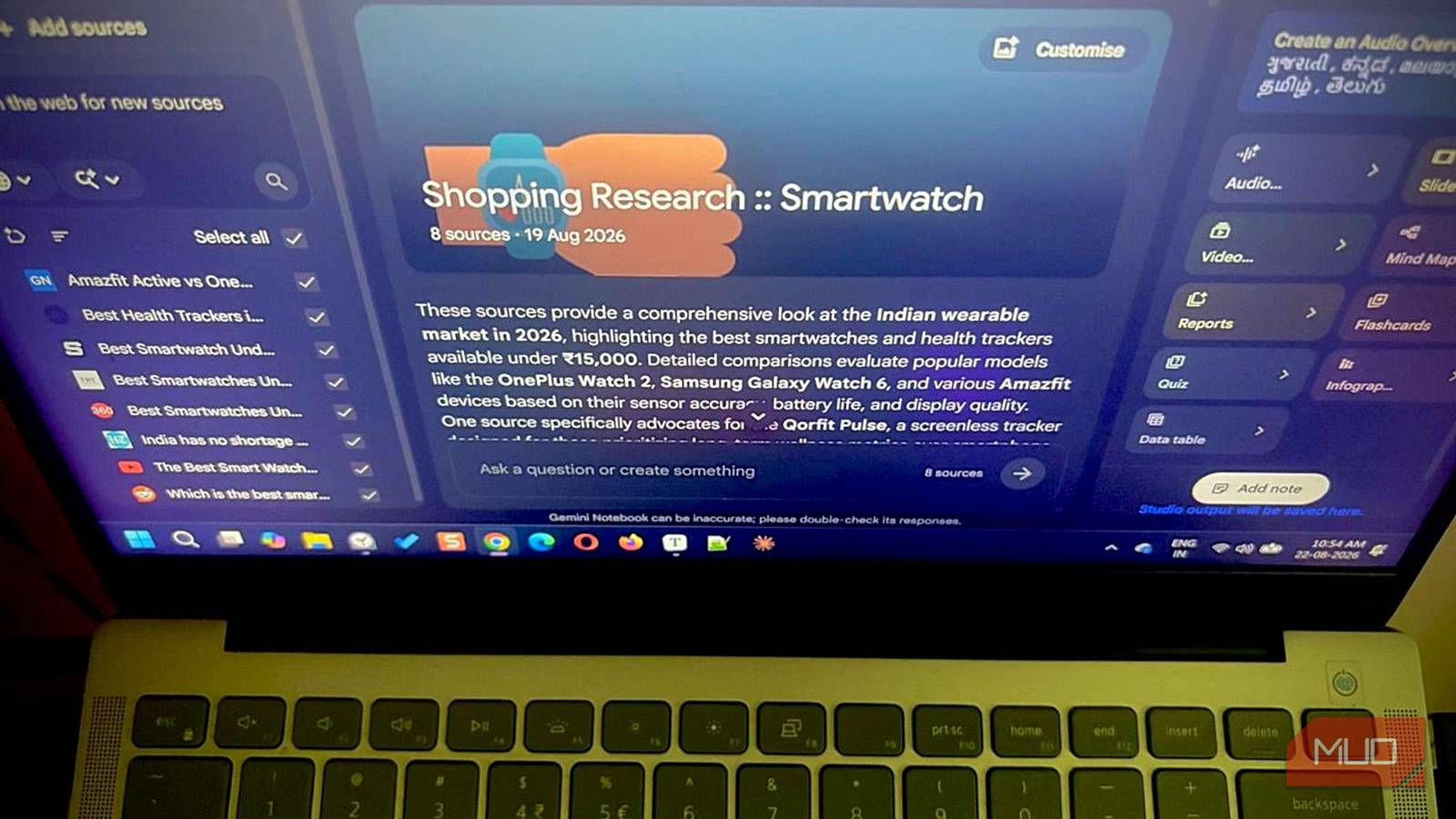
I needed a fitness tracker and smartwatch under $200. I did what I have always done. A dozen browser tabs, a few prompts in AI chatbots, and some YouTube review videos thrown in for good measure. Review sites disagreed on the brands. YouTube reviewers hyped watches, while Reddit threads became too confusing. Overwhelmed with research, I reached the point we call browser fatigue. So I tried something different. I dumped every source into Gemini Notebook and asked it to make sense of the mess. It became my filter and helped me make an informed decision.
I dumped everything into one notebook
Turning scattered tabs into one source pile

Gemini Notebook lets you upload PDFs, paste links, and drop in YouTube videos as sources. I added five review articles, two comparison pages, and three YouTube unboxings for watches under my price point. Just dumping everything feels so much better than using a spreadsheet, though Gemini Notebook can do that now too. You can also use the Deep Research option in Gemini Notebook to go deeper.
Gemini Notebook keeps each source separate and citable, so it doesn’t blend everything into mush. Gemini can find common threads between sources. Citations also help verify claims in Gemini Notebook’s answers to my prompts. This matters because I found a few attribution errors when comparing similar specs (like 10-day vs. 14-day battery claims).
I can give specific constraint prompts around what I want. Again, cross-checking with the citations helps to catch marketing or biased review fluff in the sources.
Rank these watches strictly by outdoor dual-band GPS accuracy and build quality; ignore screen brightness.
The first summary was too neutral
A comparison table helps with an overview

I started with a simple basic prompt: “Compare these watches for fitness tracking under ₹15,000.” Gemini Notebook returned a clean table with display size, battery claims, and sensor lists. You can also use the Data table Studio tool and even customize it with a prompt.
The summary was accurate, but it left the judgment to me. We need to remember that Gemini Notebook is meant to synthesize with just what’s there. It doesn’t have an opinion.
That’s fair, though: a first pass is supposed to map the terrain, not make the call. The real value showed up once I stopped asking for summaries and gave it a persona as part of the prompt. The facts in the sources stay the same, but Gemini Notebook’s voice gives you a different way to read the output.
Act as a cynical hardware reviewer who despises cheap plastics and exaggerated battery claims. Critique these two watches.
I pushed it to defend an actual opinion
Follow-up prompts turned data into a decision
I asked pointed questions next: “Which has more reliable GPS for outdoor runs?” and “Which battery claim is more realistic in daily use?” If no question strikes you, Gemini Notebook’s own suggestions below the answers are great cues.
Doubts do crop up that AI confidently picking a winner from marketing copy and scattered reviewer opinions could be a bad recommendation. It’s tough to tell because AI chatbots are so certain and neutral.
But again, Gemini Notebook backed each claim with a source citation I could click straight through to. This double-check is, in fact, the single biggest time-saver compared to manual tab searching. You can go further by telling it to play the devil’s advocate and pressure test the recommendations again.
I checked for blind spots against the sources
Catching what’s missing is just as critical

Gemini Notebook does the spadework. So it’s easy to overlook what’s missing. If none of the uploaded sources discussed finer details like long-term software support, companion app bugs, or strap durability, the recommendations have a blind spot.
Also, the original sources may not be current enough to catch promotions or seasonal sale announcements. Another prompt got me halfway there, so I at least know some of the blind spots.
Review the sources I’ve uploaded and the recommendation you gave me. Then answer these separately:
- What criteria did you use to make this recommendation? List them explicitly.
- What common buying criteria for this product category are not discussed in any of my uploaded sources? (Think: long-term software support, companion app quality, build durability over time, warranty/service experience, strap or accessory compatibility.)
- For each gap you find, tell me which sources are silent on it — don’t guess or fill it in from general knowledge.
How a clear winner emerges
Choosing between two good options

Gemini Notebook chose the OnePlus Watch 2 over the Amazfit Balance, with the caveat of discounts thrown in to bring down the price.
I still balked at buying the chosen smartwatch, as two capable watches with hit-or-miss discounts made the “one clear recommendation” promise dicey. One way to break through is to use a tiebreaker prompt. It could be a strict feature priority hierarchy based on your non-negotiable criteria rather than marketing noise.
Gemini Notebook can help filter out cosmetic perks to highlight which trade-offs actually matter for daily use. But even with the final recommendation, you still have to check availability, physical fit, and other deal-makers or breakers to make the final decision.
Based on all uploaded sources, act as an unbiased product reviewer and pick ONE definitive winner between [Product A] and [Product B]. Evaluate them using my strict priorities
Open a notebook before your next big buy
Next time you’re stuck between a dozen browser tabs and a purchase you can’t easily return, try this. Load your own sources into Gemini Notebook, ask it to argue for one clear winner, then check its work against the citations it gives you. It won’t replace your judgment, but it might finally end the tab-hoarding spiral.