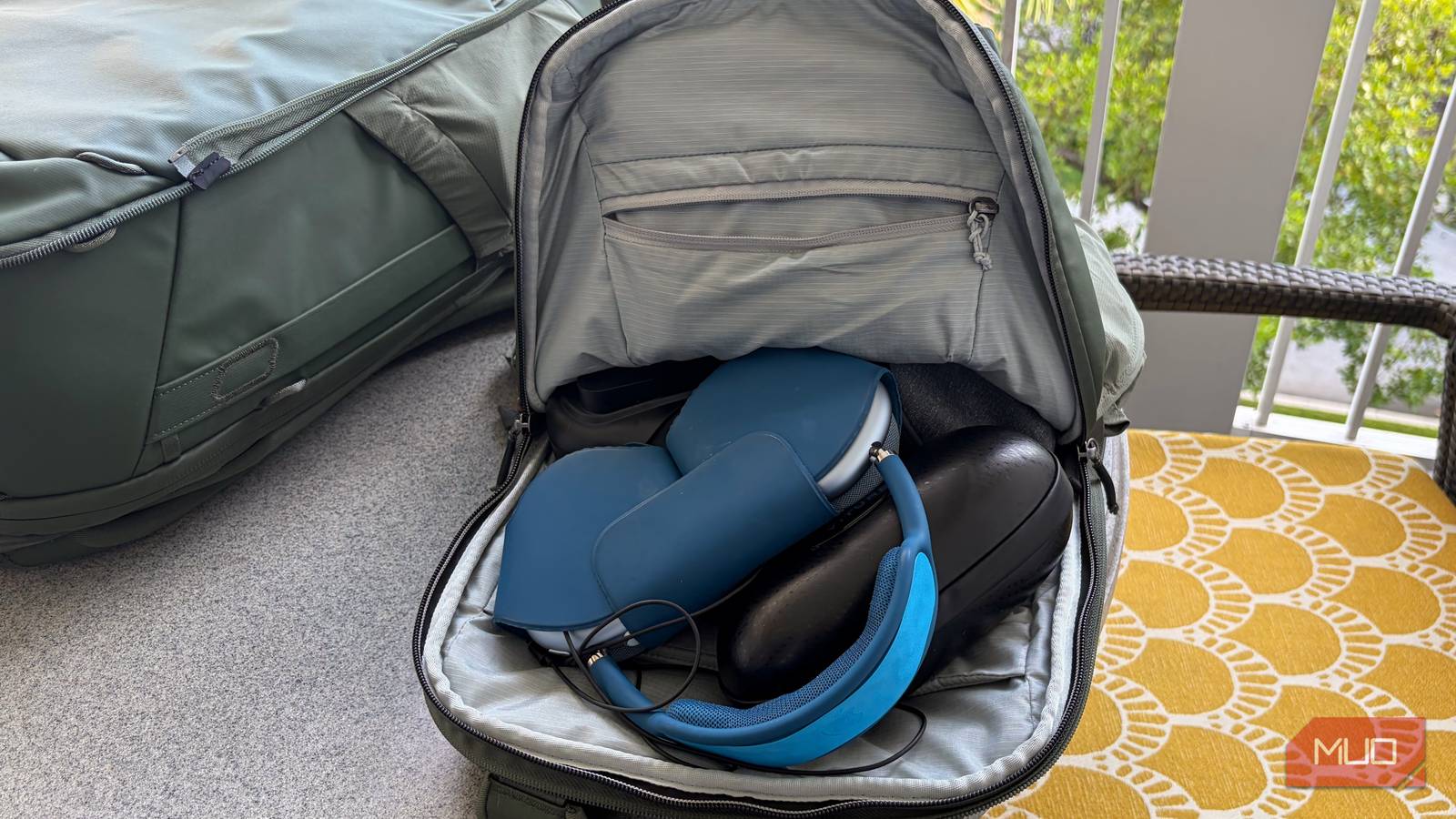
I carry an unimaginable amount of tech and gadgets with me on a daily basis. We’re talking about multiple laptops, smartphones, headphones, and a camera as the bare minimum. For travel, the list grows to typically include PC gaming handhelds, smart glasses, and perhaps a tablet. Finding a bag that can comfortably hold all the tech I need for week-long trips is tricky, especially since I prefer to keep things light and simple. Peak Design’s 2-in-1 Travel Backpack is as close as I’ve found to the perfect bag for me.
When Peak Design first sent me a sample of the 2-in-1 Travel Backpack to test, I was skeptical. I’ve tested other versions of Peak Design Travel Backpacks, and none of them really clicked. The internal compartment layouts felt overengineered and restricted, limiting how I could use the bags. Peak Design’s 2-in-1 Travel Backpack solves these problems with an open 34L main pack and a detachable 16L daypack — the latter of which is so good, it’s become my main backpack even when I’m not traveling.
This Peak Design luggage is two bags in one
I’m cheating my way to a ‘one-bag travel’ lifestyle with this combo

The concept of a 2-in-1 bag isn’t new, and the form factor solves a big problem with the one-bag travel lifestyle. Instead of bringing a suitcase, a carry-on, and a personal item, a one-bagger would replace those three pieces of luggage with a singular bag. Typically, I travel with a carry-on roller suitcase and a backpack as my personal item. Replacing those two items with a singular travel bag would leave me without a compact daypack when I reach my destination, and that’s why 2-in-1 bags exist.
A robust YKK zipper connects the main pack to the daypack, and it is strong enough to join the two bags even when overstuffed. Each bag uses Peak Design’s UltraZip zippers for its own compartments. What I loved most about this 2-in-1 backpack is how each bag can work well alone. Both the main pack and the day pack have front zipper pockets, two water bottle pockets, a laptop compartment, and an interior passport-sized zipper pocket. If you want to use the main pack or the daypack separately, you won’t be missing out on features.

The shoulder straps are excellent on both bags, although the daypack’s straps are expectedly slimmer with less padding. The main pack has an included and stowable hip belt, and both packs have sternum straps. I didn’t use the hip belt or the sternum straps — hip belts aren’t for me while traveling and the sternum strap was more trouble than it was worth. The combination is heavy when stuffed to the brim, but I moved through the airport quicker with the 2-in-1 Travel Backpack on my back than I did rolling a carry-on suitcase.
However, the two bags have strengths and weaknesses when detached. The 34L main pack holds its shape better and can stand on its own, whereas the quirky daypack design causes it to stretch and contort when fully packed. There are grab handles on the top, back, and sides of the main pack, and they’re substantial. Meanwhile, the daypack’s sole grab handle feels more like a stiff rope and will quickly hurt your hands. The daypack’s internal organization and pockets are better than the main pack’s limited pockets, although this makes the main pack excellent for use with packing cubes, camera cubes, or pouches.
How I pack my tech and travel gear in the 2-in-1 bag
Bigger items live in the main bag, tech and everyday essentials go in the daypack
I’ve used the Peak Design 2-in-1 Travel Backpack for months, and it has come with me on all sorts of trips. I took it on a three-day trip to Los Angeles, an eight-night international trip to the Bahamas, a brief road trip along the California coast, and a 2,400-mile drive across the U.S. The daypack has also become part of my everyday carry, replacing Peak Design’s 20L Everyday Backpack. Using the 2-in-1 Travel Backpack in all these ways revealed there are two ways to pack the combo.
You’ll notice that the 34L main pack and 16L daypack should add up to 50L, but the combination is advertised as being a 40L bag. That’s because you lose some capacity when the two bags are connected. It’s a bit of a puzzle trying to get everything to fit in the Peak Design 2-in-1 Travel Backpack when the two pieces are joined. If you don’t want to fight to get the two bags together, it’s best to pack them while they’re already zipped together. Put your essentials in the daypack first, and that’ll reveal how much usable space remains in the daypack.

The daypack is the bright spot of the 2-in-1 Travel Backpack I didn’t expect. It’s extremely well-thought-out, with an incredibly useful front pocket. It has a padded slot for a phone or a pair of glasses, two smaller pockets I used for my wallet and earbuds, and extra room in the middle. Better yet, I wore the daypack while running through a tropical thunderstorm, and my precious gadgets in the front zipper pocket didn’t get wet. In the daypack’s main compartment, there are two more zipper pockets, plus the aforementioned laptop sleeve.
I fit an Asus ROG Ally X gaming handheld, a MacBook, a Sony a6400 camera, sunglasses, a tech pouch, and a power bank inside the 16L daypack. That’s without mentioning all the smaller items I crammed into the front pocket. It was a tight fit, and I really wish Peak Design designed the daypack’s main compartment zipper to open wider to make packing easier. Since this is a small bag, external carry loops would’ve been nice to see. All told, I find the 16L daypack to be better suited for my everyday carry than the Everyday Backpack 20L.
Packing the 34L main pack is simple — fill it with cubes. I used a large packing cube, a wash pouch, and a few ultralight packing cubes to fit my clothes, toiletries, and more inside the main pack. With the two pieces connected, the entire 2-in-1 Travel Backpack fit inside the overhead compartment on various planes without incident, giving me some extra legroom. I could’ve brought more if I had brought a carry-on roller, but every part of the travel experience would’ve become more complicated.
The travel pack and daypack are better apart
Using them joined can be a chore, but they’re excellent detached

The Peak Design 2-in-1 Travel Backpack is for the person that needs two bags, but values the flexibility of being able to zip them together in a pinch. I enjoyed moving through airports with just one bag on my back, although the two parts of this backpack are better apart.
Now, let’s talk about the price. This backpack combination costs $400, which is sure to give anyone a bit of sticker shock. I can’t tell you whether the Peak Design 2-in-1 Travel Backpack is worth your money without knowing your specific needs, but I can put that price in context. The closest Peak Design bag to the 34L main pack is probably the Travel Backpack 20L — it has a similar open main compartment and costs $200 on its own. The closest Peak Design bag to the 16L daypack is the new City Backpack 15L, and that one costs $180 on its own.
You could buy the Peak Design 2-in-1 Travel Backpack for $400 or the Travel Backpack 20L and City Backpack 15L for $380 as a combo. The point is that the 2-in-1 Travel Backpack isn’t really overpriced for what it offers, at least in the context of Peak Design bags, or boutique bags in general. That said, if you don’t need the modularity features provided by the 2-in-1 Travel Backpack, there are certainly cheaper solutions on the market.
Peak Design’s Everyday Backpack and Travel Backpack lines were never a perfect fit for me, but this 2-in-1 solution has oddly replaced them. I grab the 16L daypack over my 20L Everyday Backpack, even when I’m not traveling. I look to the 34L main pack instead of my carry-on roller for short trips.

- Material
-
Weatherproof solution-dyed 330D nylon Versa Shell external fabric
- Bag Style
-
2-in-1
- Color(s)
-
Black, Sage, Stone
- Brand
-
Peak Design
Peak Design’s 2-in-1 Travel Backpack is designed to carry all your luggage in transit and power your day trips with a modular solution. The main pack and daypack combine with a zipper to form a 40L unit.