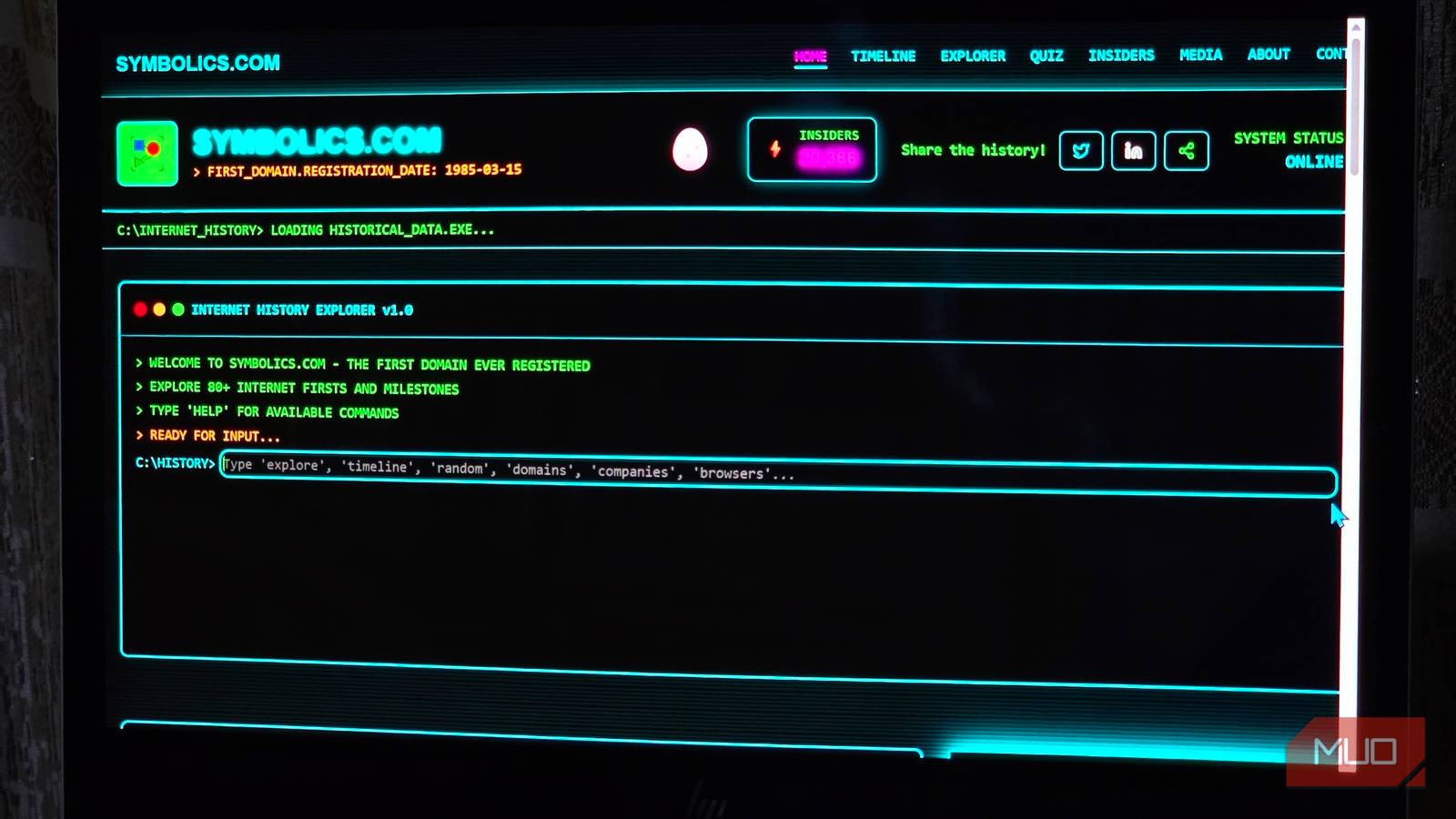
If you type symbolics.com into your browser today, the page that pops up actually looks totally ordinary. You won’t get a strange error message, you won’t need an emulator, and you won’t have to dig through the Wayback Machine like an archaeologist. The peculiar bit is sitting in your address bar.
Symbolics.com was registered on March 15, 1985, making it the first .com domain ever registered. That gives this otherwise unassuming URL a splendid bit of baggage. It was already on the internet years before websites as we know them existed, and more than a decade before I was born.
A .com with nowhere to browse

The timing is the bit that can scramble your sense of internet history. In October 1984, RFC 920 outlined an early batch of top-level domains, including .gov, .edu, .mil, .org, and .com, with .com meant for commercial organizations. Just a few months later, in March 1985, a company called Symbolics snagged the world’s very first .com address.
It’s an easy pair of terms to mash together now because most of us use “internet” and “Web” as if they’re interchangeable, even though the internet and World Wide Web are different systems. The internet is the underlying network; the Web is one service that runs across it, using browsers, servers, pages, and links.

To put that into perspective, Tim Berners-Lee didn’t even propose the World Wide Web until 1989. By the end of 1990, he had the first Web server and browser running at CERN, with info.cern.ch hosting the world’s first website. Symbolics.com had already been registered for nearly six years by then. CERN’s account of those early years also complements this history of the World Wide Web from 1989 onward.
Before domains pointed people toward websites, they were already useful as human-readable names for computers and network services. DNS could translate those names into the addressing information machines needed to reach one another. The machinery is considerably more elaborate now, but that basic lookup still happens whenever you enter a domain name today. It’s also why your choice of DNS resolver still matters in 2026.
Symbolics was exactly the sort of company to get there first
Lisp machines were serious business

“Symbolics” might sound like some mysterious, sci-fi code name today, but the company wasn’t just a couple of guys in a garage who got lucky with their paperwork.
Symbolics actually spun out of MIT’s famous Artificial Intelligence Lab and started building specialized computers in 1981. They focused on a coding language called Lisp, which was invented at MIT back in the late 1950s. Lisp became the absolute go-to language for early AI research—basically the universal language of the field at the time.
AI research of the era could demand serious computing resources, and Lisp-machine developers went a step further by designing hardware around Lisp itself. Symbolics built high-end workstations for researchers and technology companies, while its 3600 family also found its way into advanced graphics and computer animation.
Knowing that history, Symbolics landing the address makes a lot more sense. Symbolics was working at the sharp end of networked computing, with exactly the sort of people and hardware likely to encounter a new naming system before most businesses had any reason to care about one.
There’s a fun historical echo here in 2026 as well. Lisp still appears in discussions of programming languages used for AI development, while the company behind the oldest .com grew out of an AI boom several technological lifetimes earlier. The parallels aren’t perfect, but history has managed to cough up a pretty good rhyme.
Symbolics never became an IBM-sized giant, and its specialized hardware eventually slipped out of the mainstream. The company itself did not endure in its original form, but the address it registered in 1985 did.
The company left, but its address kept going
The oldest .com became a collectible
Symbolics.com stayed with its original owners until 2009, when domain investor Aron Meystedt bought it through XF.com Investments. The price was never disclosed, but Meystedt later recalled that he’d been interested in the domain for years. His timing turned out to be exquisite. Other prospective buyers had been turned away, but his inquiry landed as the company restructured and, for the first time, was willing to sell.
The current WHOIS record for Symbolics.com still names Meystedt as the registrant. It also preserves the March 15, 1985 creation date, shows an April 3, 2026 update, and lists the current registration as running through March 16, 2027.
If you go to the site today, you won’t find a preserved 1985 homepage because there never was one. Instead, modern Symbolics.com leans into its own history. It features articles about its past, domain trivia, ads, and even AI tools. There’s even a section where businesses can buy ad space on the site. Essentially, this internet museum piece has its own gift shop.
That makes the site more interesting than a fake old-school page covered in blinking GIFs. Its real age sits in the registration record, which still shows that March 15, 1985 creation date.
The address bar makes a really good museum
Domain names become valuable for all kinds of reasons. Some are super short, others have highly sought-after keywords, and some are just one-of-a-kind. The internet also has names deliberately reserved so nobody can own them, including Example.com, which can never be bought.
But Symbolics.com has a completely different kind of bragging rights. Only one .com can be first in history, and someone out there holds the keys to it.