When you buy into a power tool ecosystem, you’re not just buying the tools — the batteries are the real investment. Once you own a few batteries and chargers, you can quickly swap battery packs between tools to keep them running after one dies. Better yet, you can save money by purchasing tools separately from battery kits, leveraging the battery collection you already own. But what about the tools and household appliances in your home that don’t run on Ryobi, DeWalt, or Milwaukee batteries?
For some of those tools and appliances, the solution might be to use third-party kits to convert them to run on power tool batteries. My Dyson V8 cordless vacuum proved to be the perfect example. Its built-in, rechargeable battery started to wear out, and its proprietary charging cable wasn’t as convenient as my other power tools. Dyson does offer replacement batteries that can be easily swapped, but I solved a few problems at once by converting my V8 to use the Milwaukee batteries I already own for a fraction of the cost.
Dyson quoted me $130 for a replacement battery
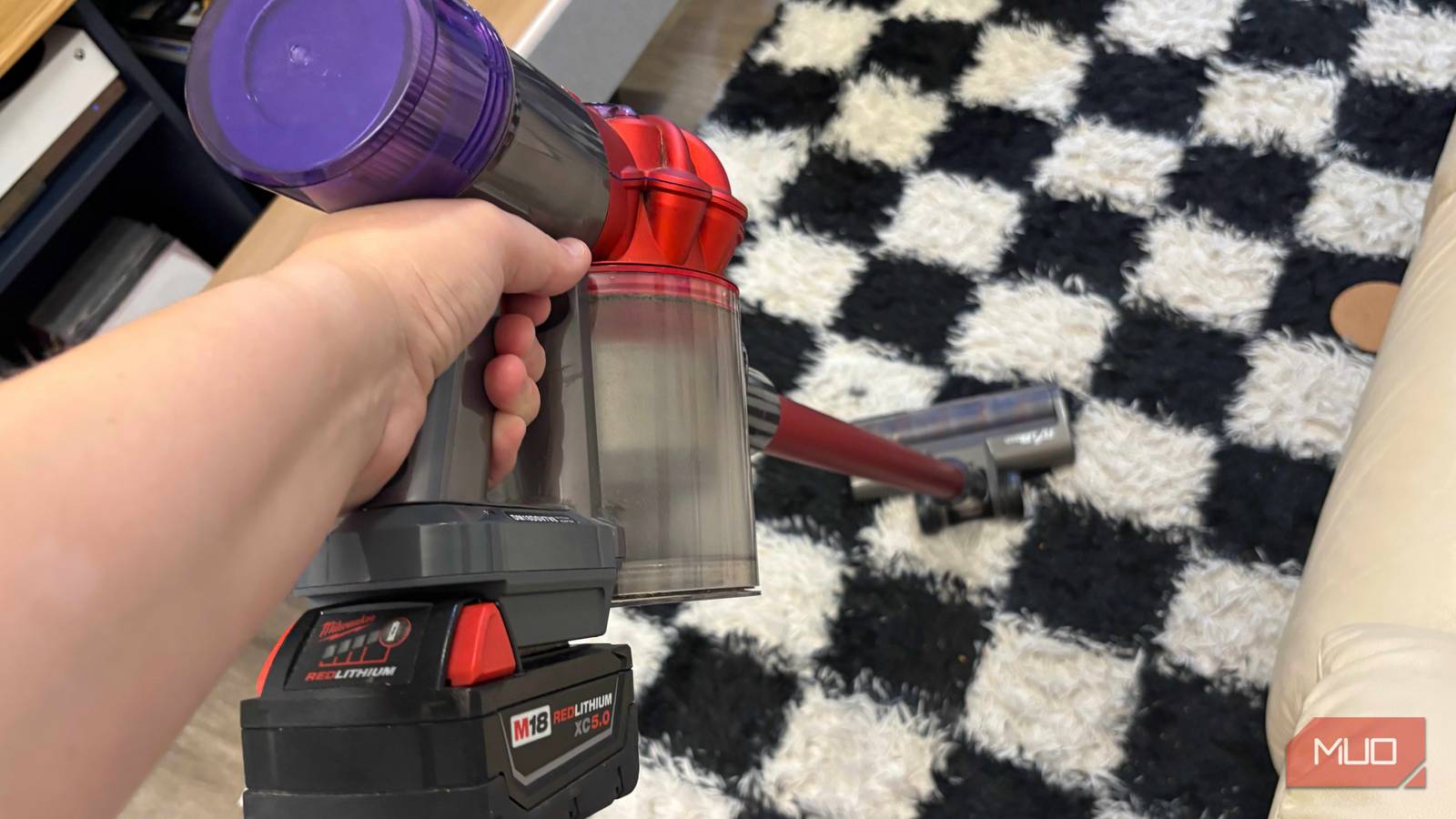
I opted to retrofit my Dyson V8 vacuum with a Milwaukee drill battery slot

All lithium-ion batteries will degrade over time, resulting in capacity loss. In practice, this means that your vacuum or drill will only run for so long before it needs to be recharged. As the tool ages, you’ll experience shorter runtimes between charges, until the battery needs to be replaced entirely to maintain peak performance. This inevitable outcome is why the removable battery model works so well for power tools. When it’s time to replace the battery, you can buy a new Ryobi, DeWalt, or Milwaukee battery pack and keep using your tools without a costly or time-consuming battery repair.
I have to credit Dyson for making replacement V8 batteries available on its online store for the average consumer to buy. I’ll also give props to the company for making the repair relatively simple — after a few screws and a handful of minutes, you can have a fresh battery in your Dyson cordless vacuum. However, as a consequence of the proprietary battery design, replacement Dyson V8 batteries aren’t cheap. They go for $130 direct from Dyson, and that’s quite the pricey part for a vacuum that costs $400 for the entire kit.
The economics of an official battery replacement for a Dyson cordless vacuum get tricky, especially for a cheaper model like the V8. By the time your Dyson V8 needs a new battery, it probably needs a good cleaning, a new filter, and other replacement parts. My Dyson vacuum’s original motorhead needed replacing before its original battery did. When you add up the repair costs and the time you’ll spend getting your vacuum in “like new” condition, the idea of simply buying a new vacuum entirely pops into your head.
Instead of buying a new vacuum or spending $130 on an OEM battery, I paid $20 for a third-party kit that makes my Milwaukee drill batteries compatible with my Dyson V8.
My Dyson vacuum has more power and lasts longer
Plus, when the battery dies, swapping in a new one takes seconds
I’ll admit, I was skeptical that a $20 part would be a reliable or worthy upgrade for my expensive vacuum. To be fair, the fit and finish of the replacement part doesn’t match the rest of the Dyson vacuum, and it isn’t as high quality. But that’s to be expected considering the price point.
Making the swap was surprisingly easy — the replacement process only requires a Phillips screwdriver. Remove two screws on the underside of the battery module and one near the filter, and you’ll have the old battery removed in no time. Install the replacement part, which slots right into the Dyson V8 in the same way as the original battery, and reinsert the screws. It took me longer to find the right-sized screwdriver than it did to complete the replacement.
With the new battery slot installed, you can use Milwaukee M18 batteries with the Dyson V8 like any other tool. Insert an M18 battery and it’ll click into place. You can use the battery status lights on the vacuum or on the Milwaukee batteries themselves to check how much charge is remaining. For the best results, use a high-capacity battery. It’s recommended to use one that’s 4Ah or higher, because Dyson batteries require lots of juice to run.
This comes with pros and cons, but the benefits outweigh the drawbacks

There are some downsides to making the switch. I have a handy charging stand for my Dyson V8, and I can’t mount the cordless vacuum to it after converting to the Milwaukee battery adapter. I now have to find somewhere to safely store the vacuum when it’s not in use. This is a small problem, but one worth noting. The bigger issue is that the heavy M18 battery on the end of a Dyson vacuum throws off the weight and balance, and it’s not as comfortable to wield as the original, unmodified vacuum.
I’ve been using my Dyson vacuum with M18 batteries for months now, and I’m glad I converted mine. My vacuum is now a power tool like every other I own, and lives within the battery and charger ecosystem I’ve spent hundreds of dollars curating. When a battery runs out, I can swap it for a new one in seconds. This beats having to wait for your Dyson V8 to recharge when it dies in the middle of a cleaning session.
I probably wouldn’t proactively make the switch if your Dyson battery is still holding a solid charge. The original battery works great before battery degradation sets in, and looks cleaner than a third-party alternative. That said, when your cordless vacuum starts losing capacity, converting it to run on drill batteries for $20 beats spending $130 on an official replacement battery or $400 on a new one.