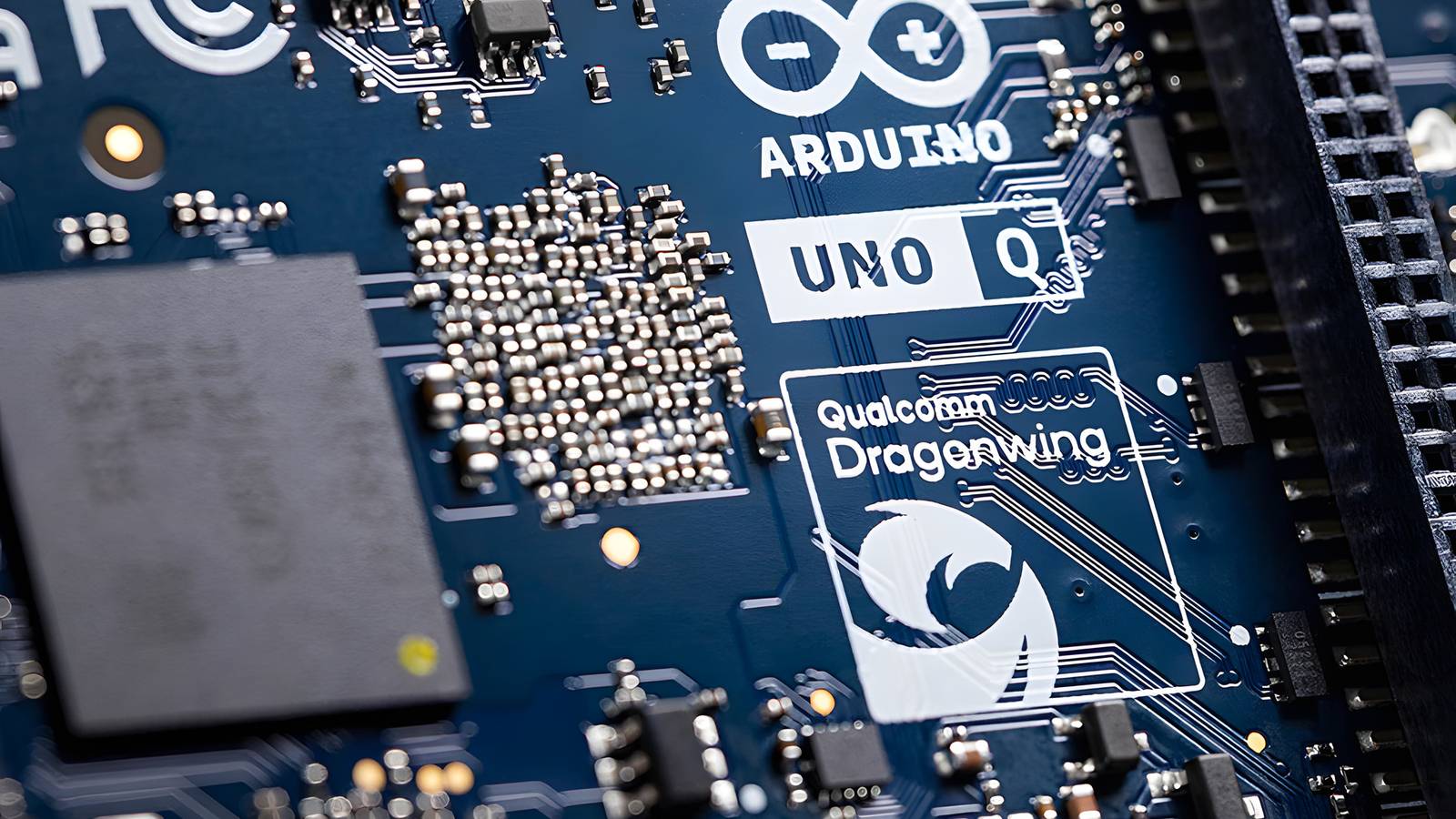
Arduino just dropped its most ambitious hardware in years, and on paper, it’s irresistible. The UNO Q, and its bigger sibling the VENTUNO Q, are dual-brain boards that pair a full Linux-capable application processor with a real-time microcontroller on a single piece of silicon-studded PCB.
Essentially, Arduino wants their new boards to replace what you’d normally need a Raspberry Pi and an ESP32 to do together. It’s a very clever idea. It’s also launching straight into one of the worst possible moments for anyone trying to sell affordable hardware.
Two chips, one board, one shared mailbox
Linux handles AI, the microcontroller handles timing
The core trick is architectural. The UNO Q runs a Qualcomm Dragonwing QRB2210, a quad-core Cortex-A53 chip clocked at 2 GHz with an Adreno 702 GPU, paired with an STMicroelectronics STM32U585 microcontroller running Arduino sketches on Zephyr OS. The Linux side handles Debian, Python, and AI workloads, while the microcontroller handles the deterministic, real-time GPIO work the Arduino has always been loved for.
What this means is that you get a Raspberry Pi-style Linux computer and an ESP32-style microcontroller talking to each other over a fast internal bridge, all in the classic UNO footprint. Arduino’s new App Lab IDE ties the two together, letting you write Python for the Linux side and C/C++ sketches for the real-time side in one workflow.
The bigger VENTUNO Q pushes this further, with a Qualcomm Dragonwing IQ8 processor delivering up to 40 TOPS of NPU performance, the same that Microsoft requires to call a Windows PC an AI one, with up to 16GB of LPDDR5 memory. It explicitly targets local LLM and vision inference rather than simple automation.
Finally, one board instead of two duct-taped together
No more duct-taping a Pi and an ESP32 together

As someone who’s constantly had to duct-tape a Raspberry Pi and Arduino or ESP32 together because neither one alone could do the job, this concept is legitimately amazing. Real-time control and general-purpose computing have always lived in separate silicon worlds; you needed a microcontroller for motor timing and sensor polling, and a full OS for anything involving networking stacks, camera pipelines, or AI inference.
Cramming both into one board, at a starting price of $44 for 2GB of RAM, undercuts a comparable Raspberry Pi 5 setup while adding capabilities neither Pi nor ESP32 has on its own.
Then the price went up by a third
Memory costs, not Arduino, wrote this price hike

Just months after launch, Arduino raised UNO Q prices by roughly a third, pushing the 2GB board from $44 to $59 and the 4GB variant from $59 to $79, citing memory costs directly in the announcement. That’s not a rounding error, and it lands at the worst possible moment for an otherwise great board.
The entire single-board computer market is being squeezed by an AI-driven DRAM and NAND shortage that has sent Raspberry Pi prices spiraling. The 8GB Pi 5 has climbed from $80 at launch to over $175, and the 16GB model has more than doubled, now selling at nearly $300. Raspberry Pi itself has had to tap credit facilities just to secure enough memory inventory to keep production running.
On top of that, a fresh wave of US semiconductor tariffs took effect in January 2026, imposing duties as high as 25 percent on certain advanced chips and derivative products. This adds yet another cost variable for any board build around imported silicon.
Every competitor is getting more expensive at the same time
Raspberry Pi is borrowing money just to buy memory
None of this is really Arduino’s fault, but it undercuts the board’s entire value proposition. The whole appeal of the UNO Q was that it offered SBC-plus-microcontroller flexibility at a price that beat buying two separate boards, and that math gets shakier every time memory costs rise.
Meanwhile, the VENTUNO Q, Arduino’s most powerful edge-AI flagship, has launched at an introductory price of $299, a price still steep for the traditional hobbyists that make up Arduino’s major customer base. That’s a tough sell when a Raspberry Pi 5 or an Nvidia Jetson Orin Nano occupies adjacent price and performance tiers, and when many buyers are already feeling sticker shock around the entire SBC category.
A great board, arriving at the worst possible moment
Engineering isn’t the variable that decides this one
The UNO Q and VENTUNO Q represent a real architectural leap, not just a marketing gimmick, and the dual-brain concept solves a genuine pain point for hobbyists juggling separate real-time and Linux-capable boards. But launching into a market where DRAM costs are climbing monthly, tariffs are reshuffling supply chains, and even Raspberry Pi is borrowing money to secure memory means Arduino’s pricing advantage erodes in an instant.
And that’s before the ecosystem, software polish, and community projects can even catch up. It’s a smart board arriving at an unlucky time, and whether it succeeds may depend less on engineering than on how quickly the memory market cools off.