I’ve completely switched over to USB-C gadgets, and that means the same charger can power everything from my camera and smartphones to my over-ear headphones and laptops. It’s the universal charging experience I always wanted, with a caveat. Each device has unique requirements that must be met by a USB-C cable and power adapter in order to charge at their fastest speeds. Apple, Samsung, and Google all tout fast wired charging speeds, but you won’t see them using any old charger.
Although the USB Power Delivery standard was supposed to simplify matters, it hasn’t. It’s no longer enough to check for the USB PD certification on the box of a new charger. You need a USB PD power adapter with Programmable Power Supply (PPS) support, and it must be 27W or higher. Find a charger that checks all those boxes, and you’ll be able to charge any iPhone, Pixel, or Galaxy at their top speeds.
Pixel and Galaxy phones need PPS
This feature lets your phone charge at its fastest
The latest phones from Samsung and Google don’t charge as fast as their global competitors, but to achieve their peak charging performance, you need a PPS charger. The Google Pixel 11, Pixel 11 Pro, and Pixel 11 Pro Fold all charge at 30W over a cable. The high-end Pixel 11 Pro XL charges at a faster 45W rate. Meanwhile, the Galaxy S26, Galaxy S26 Plus, and Galaxy S26 Ultra charge at 25W, 45W, and 60W wired speeds, respectively.
Those advertised speeds are only attainable with a certified USB PD charger with PPS support. Older chargers could only adjust real-time wattage and voltage within pre-set tiers. Your smartphone negotiates how much power is delivered based on how much it can accept. This changes dynamically based on the phone’s battery level and temperature. However, if a charger can’t match the exact voltage a phone is asking for, it has to step down to a lower pre-set tier.
This results in slower charging speeds, and it’s why PPS is important. PPS chargers can adjust their voltage more fluidly, between 3.3V and 21V. The voltage and current are tweaked in small, precise increments. Specifically, a PPS charger is capable of adjusting voltage and current in 20mV and 50mA steps.

Pixel and Galaxy phones leverage PPS chargers to avoid leaving faster charging speeds on the table. An old-school USB PD charger could be limited to imprecise 15V and 9V steps — a phone that wants to accept a voltage somewhere in the middle must step all the way down to 9V and charge slower. With a PPS charger, a Pixel or Galaxy phone can charge at the exact voltage and current tier it requests, within 20mV and 50mA increments.
After you’ve found a PPS charger for your devices, you’ll want to check its wattage and maximum voltage capabilities.
Not any PPS charger will do the job
iPhones are picky, and need a PPS charger with AVS

I wish it were as simple as picking up a USB PD charger with PPS support, but it’s not. You’ll need to first make sure the PPS charger you’re considering supports a wide enough voltage range. While some power adapters with PPS compatibility are limited to 11V or 16V maximums, some phones require PPS chargers to reach 21V. The Pixel 11, Pixel 11 Pro, and Pixel 11 Pro only need 11V PPS chargers, but the Pixel 11 Pro XL requires a 21V PPS charger.
iPhones require a fast-charging standard of their own called Adjustable Voltage Supply (AVS). It’s quite similar to PPS, but AVS is more limited in its voltage range and the scope of its adjustments. Chargers with AVS can fluctuate between 9V and 20V, and the adjustments come in 100mV increments. It’s not as versatile as PPS, which can move between 3.3V and 21V in 20mV increments.

AVS is a lesser version of PPS, and the good news is that the best PPS chargers support both standards. Any charger that meets the USB PD 3.2 specification, supports PPS, and can deliver at least 27W of power also has AVS support. It works within the USB PD standard power range, which covers chargers between 27W and 100W.
Grab a charger with USB PD 3.2 PPS support, between 27W and 100W, and you’ll be able to charge any iPhone, Pixel, or Galaxy.
One charger to rule them all
This charger can power my laptops, too

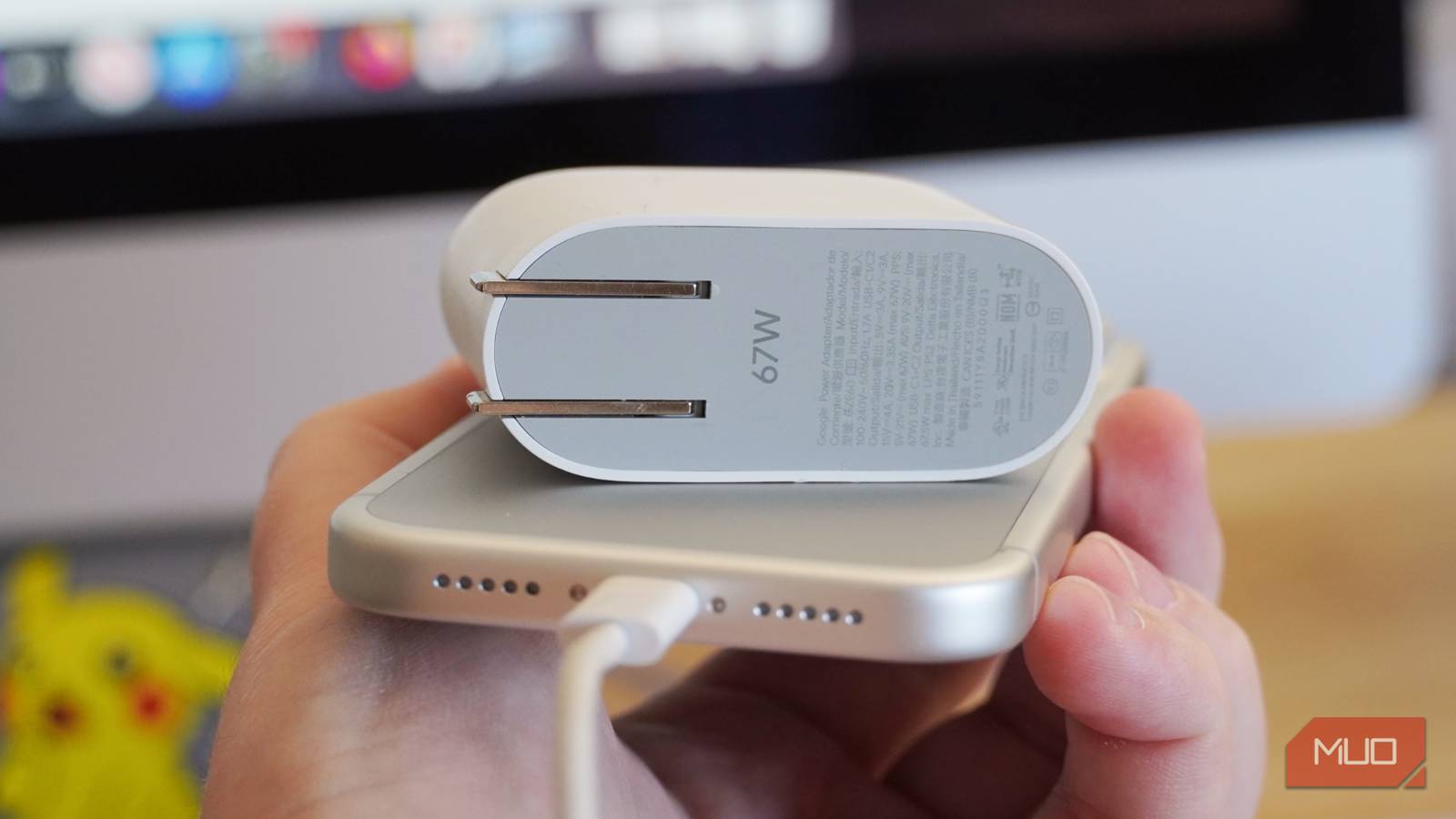
Charging specifications clearly still need work, because finding the right power adapter for all your devices entails completing a three-part checklist. Google has a charger with USB PD 3.2, PPS, and AVS support — the Pixel Flex Dual 67W charger — and it’s the most versatile power adapter I’ve tested. It can charge just about any USB-C device at its peak speeds, save for power-hungry laptops.
However, Google is far from the only company making fast USB PD chargers. Any certified USB PD 3.2 charger between 27W and 100W with PPS will do the trick, so you can pick the one you like best.

- Output
-
2x USB-C
- Output Power
-
67W
- Color
-
Snow (White)
- Smart Features
-
USB PD: 3.2 PPS PD: 5V/3A, 9V/3A, 15V/4A, 20V/3.35A max 67W PPS: Up to 11V/3A, 16V/4A, 21V/3.35A max 67W AVS: 9-15V/4A, 15-20V/3.35A max 67W
The Pixel Flex Dual 67W charger is a fast USB-C power adapter that can fast charge two high-end Pixel phones simultaneously. It also includes USB PD 3.2, PPS, and AVS support, allowing it to charge modern devices like the iPhone 17 or Pixel 10 Pro XL quickly.