I use Android phones, iPhones, MacBooks, and Windows laptops, and finding a single USB-C charger to power them all proved to be a challenge. USB-C power adapters and cables all look similar, but the charging standards they support can vary greatly. If you’ve ever plugged a USB-C cable into a phone or laptop and noticed slower charging speeds than expected, you’ve experienced this discrepancy firsthand.
A base level of continuity allows you to plug a charger with a Type-C connector into almost any modern gadget, but a handful of convoluted charging standards will determine if that charger can actually power your device. I use a five-point checklist when buying a new charger, and if it meets every requirement, I know it’ll be able to charge any device I connect.
60W or higher
Fast chargers are great, but 60W is the sweet spot

Wattage is the spec that stands out when buying a charging cable, power adapter, or wireless charging pads. On the high end, you’ll see product listings touting chargers with 100W or 240W speeds — powerful enough to charge a laptop (or even a mini PC). Of course, you can opt for a 100W or 240W charger for the most power, but I’ve found the sweet spot to be around 60W.
The problem with high-wattage power adapters is that they’re larger and more expensive than ones with a lower maximum wattage. The extra cost makes it difficult to build out a kit with multiple high-wattage power adapters, and the larger size makes them worse suited for travel. A large and heavy power adapter might slip out of loose power outlets at high-use areas like coffee shops or airports. I usually keep one or two high-wattage power adapters in my bag, but not every charger needs to be 100W or 240W.
A 60W charger offers the perfect compromise between size, cost, and performance. It’s fast enough to charge the entire Google Pixel 11, Samsung Galaxy S26, and iPhone 18 Pro lineups at their fastest speeds. It can even charge small laptops easily, as the MacBook Air only demands 35W of power.
In a pinch, I can connect power-hungry laptops like my MacBook Pro to a 60W charger. It’s slower than using a 100W or 240W charger, but a 60W charger can power everything in my bag without the drawbacks of a larger and more expensive power adapter.
USB PD 3.2
If there’s only one spec you look for, it should be this
The single most important spec to consider when buying a new charger is its USB Power Delivery (USB PD) version. It greatly impacts how fast a charger can power your devices and which modern charging standards it supports.
The specific version to watch out for is USB PD 3.2. If a charger supports USB PD 3.2 and can hit speeds faster than 27W, you know it also supports Adjustable Voltage Supply (AVS) without combing the spec sheet further.
The mandatory AVS support is important, because older USB PD chargers only allowed for optional Programmable Power Supply (PPS) support. The USB PD 3.2 Standard Power Range covers chargers up to 100W, whereas the Extended Power Range refers to chargers above 100W up until the 240W limit.
In other words, if you see a 60W charger with USB PD 3.2 support, it’s guaranteed to support AVS. That means it can adjust its output voltage in 100mV increments between 9V and 20V, giving the connected device exactly the amount of power it can receive at each point in the charging cycle.
PPS and AVS
You’ll need this to charge your phone at its fastest

Adjustable Voltage Supply (AVS) is guaranteed on USB PD 3.2 chargers above 27W, but Programmable Power Supply (PPS) isn’t. For the best compatibility with all kinds of devices, you’ll want to specifically seek out a PPS charger. The latest iPhones use AVS to charge at their fastest speeds, but the newest Android phones require PPS chargers for the best performance.
AVS and PPS are both charging standards that allow power adapters to adjust their current voltage in small increments, but PPS is more granular. It adjusts voltage and current in 20mV and 50mA steps, whereas AVS is limited to 100mV stages.

The voltage range of PPS chargers is also wider, between 3.3V and 21V. As a reminder, AVS works between 9V and 20V for 45W to 100W chargers, and in a more limited 9V and 15V range for chargers above 27W and below 45W.
Without a PPS-equipped charger, your device will move between pre-set voltage tiers, such as 15V and 9V. The large drop in voltage between stages effectively means your device is leaving faster charging speeds on the table. While you can pick either AVS or PPS if you’re strictly an iPhone or Android user, buying a charger that supports both standards is the best way to ensure fast charging on any product.
Qi2 25W
This one is a must for wireless chargers
It’s easy to forget that wireless chargers have their own set of standards. If you’re buying a wired charger, there’s no need to look for a Qi2 logo. If you’re choosing a wireless charging stand, pad, or car mount, it’s absolutely essential. Qi2 25W is the spec to find on the label, and it’s sometimes referred to as Qi2.2. Wireless chargers with Qi2.2 can charge at 25W speeds, which is a ten-watt upgrade over the base Qi2 standard.
Qi2 25W is backwards-compatible with Qi2 and Qi devices, so there’s no downside to buying a more powerful charger than all your devices support. If you have a new iPhone or Pixel, you’ll be able to take advantage of the faster speeds.
Be sure that the power adapter used to power the wireless charger is up to the task. A single-device charger needs a 25W power adapter, but multi-device charging stations will need a power brick with enough wattage to comfortably power every pad.
Your chargers should meet the needs of your devices
A charger doesn’t need to meet every requirement on this list to adequately charge your devices. However, if it checks every one of these boxes, you don’t have to play the guessing game every time you connect a new device. You can safely skip specs like Qi2 25W if you’re buying a wired charger, or skip PPS if you’re strictly an iPhone user (get an AVS charger).
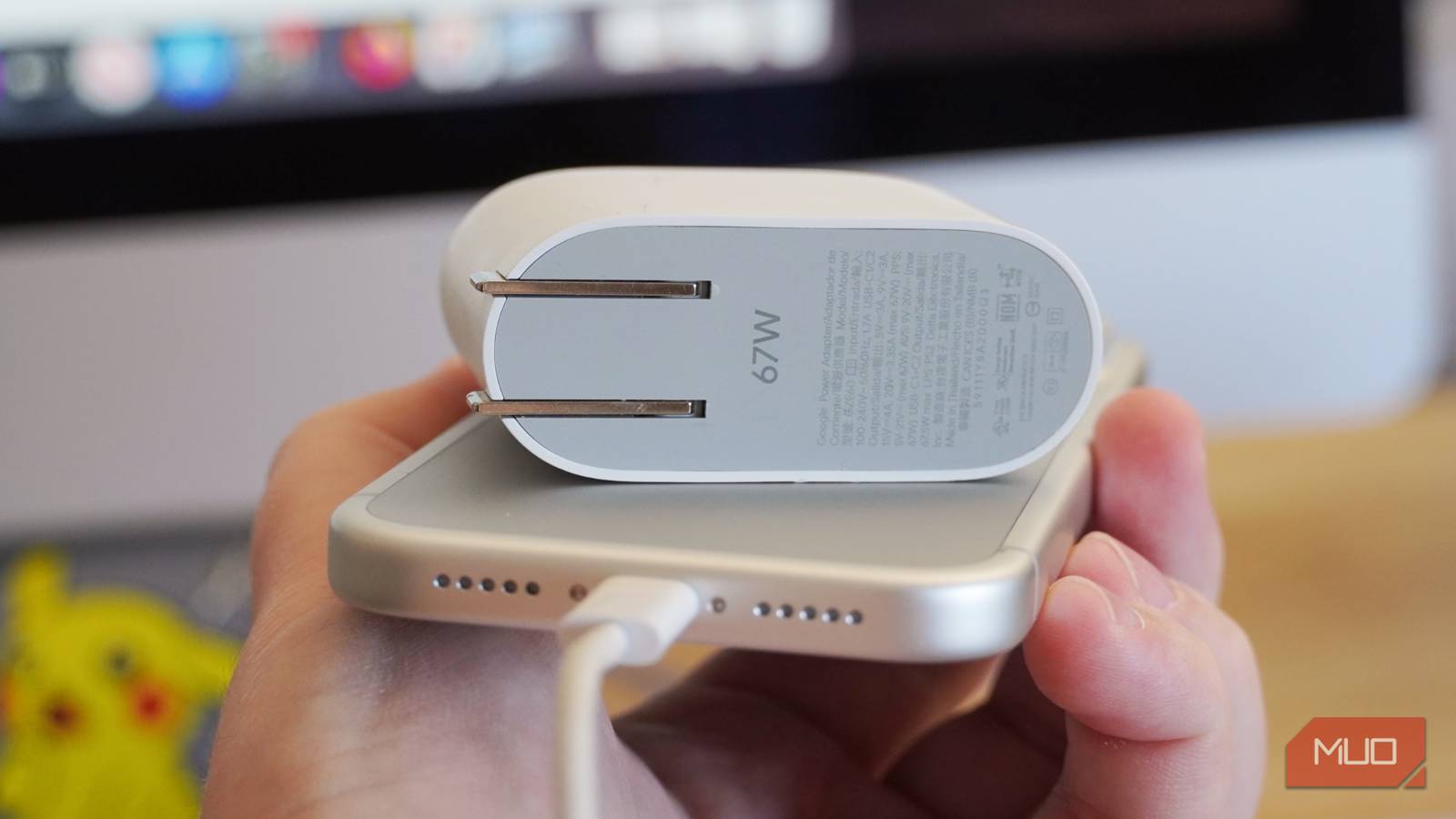
If you’re like me and use a variety of devices with their own power and charging demands, the safe option is to pick up a charger that meets most or all of these requirements. The Pixel Flex charger is one of the few I’ve used that meets my 45W, USB PD 3.2, PPS, and AVS requirements, and it can also power a Qi2 25W wireless charger you buy separately.

- Output
-
2x USB-C
- Output Power
-
67W
- Color
-
Snow (White)
- Smart Features
-
USB PD: 3.2 PPS PD: 5V/3A, 9V/3A, 15V/4A, 20V/3.35A max 67W PPS: Up to 11V/3A, 16V/4A, 21V/3.35A max 67W AVS: 9-15V/4A, 15-20V/3.35A max 67W
The Pixel Flex Dual 67W charger is a fast USB-C power adapter that can fast charge two high-end Pixel phones simultaneously. It also includes USB PD 3.2, PPS, and AVS support, allowing it to charge modern devices like the iPhone 17 or Pixel 10 Pro XL quickly.