“Switch your DNS to Cloudflare or Quad9 for a faster internet” shows up in enough forum threads and comment sections that most folks go looking for proof.
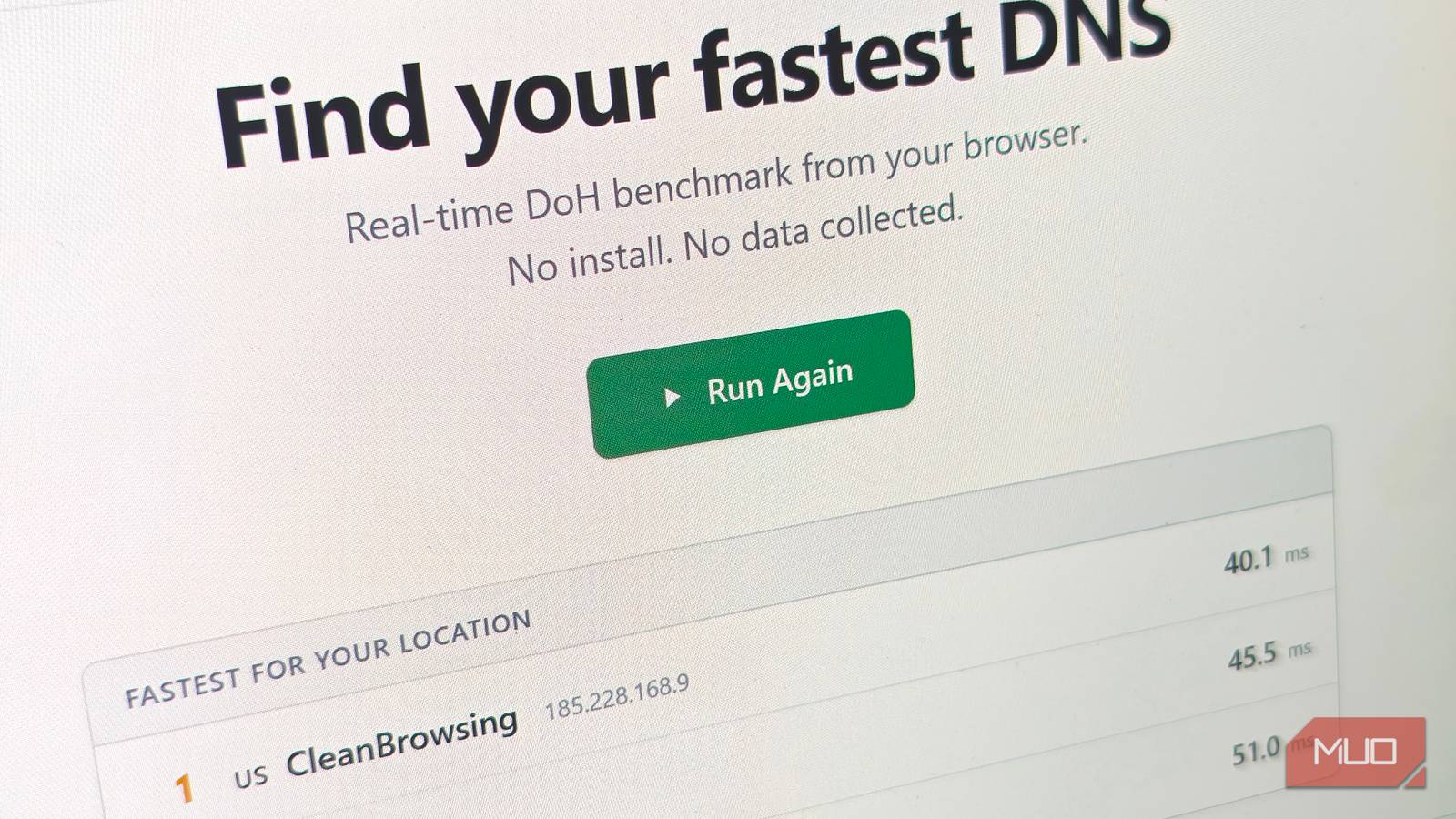
The next step is a DNS speed test. You fire up a tool like DNS Speed Test, watch the numbers tick down and sort themselves, and head for the resolver on top.
Except the test most folks reach for isn’t measuring what they think it is — and even paid DNS testing tools might not reveal how your internet will feel, or the benefits of switching to begin with.
Everyone heads to this free and easy-to-use DNS test
DNS Speed Test is a great tool
If you’ve gone looking for a quick DNS comparison, you’ve probably landed on DNS Speed Test. It’s free, it runs entirely in your browser, and it needs zero installation, which makes it a great option for most folks. I’ve used it myself numerous times over the years as part of DNS testing for the fastest resolver, comparing it to other tools, and similar.
You hit the button, and DNS Speed Tests benchmarks your connection against more than 28 DNS-over-HTTPS (DoH) servers using nothing but your browser’s own network calls; it’s a fantastic effort from Silviu Stroe, the solo-dev behind this project.
DNS Speed Test doesn’t necessarily give you the best option
It’s not entirely wrong; it’s just not the full picture

There are a couple of reasons why DNS Speed Test’s numbers aren’t quite what they seem.
First, before the test times resolvers, it runs a warm-up phase, priming the TCP and TLS handshakes for each server so that overhead doesn’t skew the results. It’s actually quite a useful step to ensure consistency across tests.
But it also means that, to a degree, the resolution times have had some waiting time reduced, which can make some tests appear slightly better than others. For example, a fully cold DNS test means your first query will take longer, due to the nature of DNS queries, handshakes, and cache population.
Warm-Up Phase: Before timing each DNS server, the script primes connections and caches to minimize TCP/TLS handshake overhead. This more fairly represents typical DoH performance once connections are established.
The other mismatch is that DNS Speed Test specifically targets DNS-over-HTTPS (DoH). While it is completely valid to test for, it’s not necessarily how most folks use DNS or how most devices resolve domains day to day.
That said, while DoH might not completely represent your current DNS setup, making the results seem slightly off, I absolutely can’t deny that presenting these results is a massively positive step in moving people to more secure DNS resolvers.
DNS testing typically only reveals the lookup, but not the connection
It’s a common problem across most DNS speed tests

There is another issue with many DNS speed testing tools, and one that most testing apps don’t reveal. It’s that, for the most part, DNS resolution finishes before your device even opens a connection to the site you’re trying to reach. Once that handshake happens, DNS is out of the picture completely.
One of the common misconceptions of DNS speed testing is that faster resolution means a faster connection. But it doesn’t affect your network latency, jitter, packet loss, or anything else.
A resolver that wins a benchmark by 20ms is winning a race that happens once per domain, on a leg of the trip that ends before the part you actually feel begins.
GRC Benchmark V2 is where the real results live

For anyone who wants a more rigorous comparison than a browser tab can offer, Steve Gibson’s GRC DNS Benchmark is the tool built for it. Version 1 was free, but it was designed back in 2009, for a web that looked nothing like today’s. Version 2 costs $9.95 for a one-time, lifetime license.
V2 tests resolver through five times more query sets by default, compares DoH and DoT resolvers side by side with plain DNS, and ships with a far larger resolver list, well over a hundred servers across all four connection types.
It’s just a much more accurate measure of raw DNS query time in relation to your actual connection (not forgetting that DNS doesn’t actually make your connection faster!).
As said, I’m a big fan of DNS Speed Test. It’s fast, free, accurate with what it tests, and it means more folks are likely to actually consider how DNS affects their connection. I’m not suggesting anyone stop using it; I’m just explaining a bit more about how it works.
DNS Speed Test does something better than any other tool, too: it pushes folks to use DoH, which means fewer eyes on your browsing habits and a general privacy boost, for free, and that’s something I can get behind massively.
But if you ever feel like you want more detailed information, you know which app to turn to.